


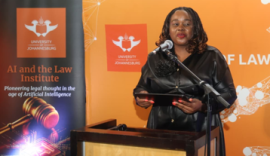
Minister of Justice and Constitutional Development Mmamoloko Kubayi has warned that artificial intelligence (AI) systems largely trained on foreign datasets risk perpetuating racial bias and undermining South Africa’s transformative constitutional vision if they are not infused with local historical context.
The Minister delivered remarks at the University of Johannesburg’s “AI and the Law” conference.
She explained that while AI-powered solutions could drastically reduce legal costs and delays, the same technology could just as easily increase access to injustice if deployed without transparency, accountability and data that reflects the country’s apartheid past.
“African Data which carry our archives, African languages and cultural nuance, do not find expression in the AI machines that are currently used in the various fields, including law. Most AI is trained on datasets from North America and Asia.
“This exclusion perpetuates data poverty and algorithmic bias, leading to real-world consequences such as poor language translation machines, especially for African languages.
“The bigger risk for our country in respect of the law is the use of AI machines which are totally devoid of our historical context as a country,” Kubayi said on Thursday.
She acknowledged that despite the challenges presented, AI systems stand to increase justice for all.
“Among the factors that have been a barrier to the achievement of universal access to justice are prohibitive legal costs, geographic remoteness from courts and legal services, lengthy delays in case resolution, and a shortage of legal practitioners willing or able to serve lower-income communities.
“Undoubtedly, by automating repetitive processes, advancing legal research, drafting, increasing dispute resolution, and encouraging predictive legal analytics, the introduction of AI-powered solutions has drastically transformed the delivery of legal services.
“The effect of AI-powered tools does not only reduce the time it takes to perform these tasks, but they also do these tasks at a fraction of the traditional cost. The effect of these developments is the rapid increase of access to justice,” the Minister noted.
Probing questions
She noted that South Africa’s Constitution is transformative and was drafted to “heal the divisions of the past” and lay a foundation for social justice.
“As a country we have seen and experienced the horrific consequences of a nation organised through racial segregation. We need to ask ourselves: what is it that we need to do [so] that technological progress is not concomitant with the growth of digitised racial segregation?
“The data that carries our history and our social context has been excluded in the development of the AI machines that are currently in the market. How then should we expect that the machines which are, in all likelihood, biased against us will be able to help us build a just society? Are we not, in our quest to increase access to justice through AI, at the risk of increasing access to injustice?” Kubayi enquired.
She encouraged leaders of the universities to “help to answer this question and many other questions that have arisen with the development” of AI.
“I have no doubt this conference will attend to all these very important issues so that we can be able to utilise AI to advance the Sustainable Development Goals through Law, Governance and Practice.
“I look forward to the outcomes of this conference. I wish you all the best with your deliberations,” Kubayi concluded. – SAnews.gov.za


