


The Department of Agriculture has allocated R3.2 billion to food security and farmer support programmes, the largest share of its 2025/26 Budget Vote, as government intensifies efforts to drive inclusion, productivity and job creation across the sector.
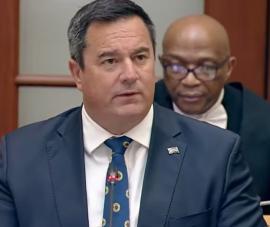
Presenting the department’s Budget Vote in Parliament on Friday, Agriculture Minister John Steenhuisen said the allocation to Programme Three, Food Security and Support, underscores the central role of farmer support and extension services in unlocking productivity and inclusion.
Programme Two, covering biosecurity, research and natural resource management, has been allocated R2.5 billion, with a significant portion directed towards strengthening research, diagnostics and export compliance systems.
“Of this amount, approximately R494 million has already been spent, with a remaining balance of R1.607 billion earmarked for the continuation and expansion of the vaccination programme,” the Minister said.
Programme Four, Economic Development, Trade and Marketing, was allocated R924 million to continue driving market access, addressing tariff and non-tariff barriers, and supporting the integration of producers into higher-value segments of the market.
Unlocking jobs across the value chain
Steenhuisen said the budget is aligned with government’s broader target of expanding agricultural value-add by 30% and unlocking 300 000 jobs across the value chain.
He highlighted that the sector already supports close to 950 000 jobs across the value chain, with additional employment gains driven through targeted interventions.
The Blended Finance Scheme, implemented in partnership with development finance institutions, has supported over 14 000 jobs, including about 7 869 through the Industrial Development Corporation (IDC), and more than 6 480 via the Land Bank.
Further employment is being created through government’s extension support initiatives, with 370 Assistant Agricultural Practitioners already deployed to strengthen frontline advisory services to farming communities across the country.
A total of R306 million has been set aside over the Medium-Term Expenditure Framework toward the employment of Assistant Agricultural Practitioners working alongside provincial departments.
Steenhuisen highlighted the role of agro-processing and energy-linked initiatives in driving future employment.
The Agro-Energy Fund is supporting investment in irrigation and cold-chain infrastructure, while the proposed biofuels blending programme could generate up to 25 000 jobs, particularly in rural areas.
“Growth in agriculture must translate into real opportunities on the ground. This budget is directed at deepening value chains, expanding market access and ensuring that more South Africans participate meaningfully in the sector.”
Agricultural exports reached R268.7 billion
The Minister also noted continued export growth as a key driver of economic activity.
Agricultural exports reached R268.7 billion in the fourth quarter of 2025, reflecting a 9% year-on-year increase and a trade surplus of R24.6 billion for the period.
South Africa has also expanded its global footprint, securing new market access for products including citrus, table grapes and stone fruit in countries such as China, the Philippines and Vietnam.
The country recently became the world’s largest citrus exporter by volume, shipping 2.9 million tons in 2025.
Government is investing in regulatory reform and biosecurity to sustain export competitiveness.
The Minister said the Agricultural Research Council (ARC), which received the largest share of entity funding, is scaling up local vaccine production to support disease control, including efforts to combat foot-and-mouth disease.
He emphasised the importance of strengthening domestic capacity to safeguard the livestock industry and ensuring long-term sustainability.
The budget also prioritises smallholder integration into formal markets.
Through the SA-GAP (South African Good Agricultural Practices) certification programme, implemented with the Perishable Products Export Control Board, 740 producers have been supported, with plans to reach 1 700 more farmers in the coming year.
Despite progress, the Minister acknowledged that structural challenges remain, including uneven transformation and concentration in key subsectors.
“Agriculture has always been a sector of quiet resilience. But in the years ahead, it must become a sector of deliberate growth. Growth that is inclusive, export-oriented, and translates into jobs, investment, and opportunity,” Steenhuisen said.
He added that government would continue to focus on improving infrastructure, expanding market access and strengthening partnerships across the value chain to ensure that growth translates into jobs, investment and broader economic opportunity. – SAnews.gov.za


