


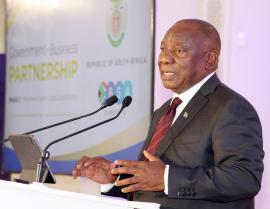
President Cyril Ramaphosa says the success of the Government-Business Partnership will ultimately be measured by whether economic growth translates into jobs, rising incomes and improved living conditions for South African households.
Speaking at the launch of Phase Three of the Government-Business Partnership in Johannesburg on Thursday, the President said the partnership must now move beyond stabilising the economy and implementing reforms towards delivering sustained and inclusive growth.
“It must be about ensuring that economic recovery is felt not only in improved balance sheets, stronger markets and favourable economic indicators, but in the lives of the South African people,” President Ramaphosa said.
The President said South Africans could not be expected to live on the promise of future economic growth, stressing that the impact of the country’s economic recovery must be experienced in the present.
“Above all, we must act with urgency. South Africans cannot live on the promise of future growth. They need to experience progress in the present.
“They are looking to us to demonstrate that partnership can produce results, that reform can improve lives and that growth can restore hope,” he said.
President Ramaphosa said Phase Three must convert the progress achieved through the partnership into investment, productive economic activity and jobs.
“Confidence must lead to investment. Investment must lead to production. Production must lead to jobs. And jobs must lead to better lives,” President Ramaphosa said.
The President said the immediate objective was to lift economic growth above 3%, while cautioning that this should not be regarded as the ultimate ambition.
“But growth of 3% cannot be the summit of our ambition. It is a necessary threshold from which we must advance towards higher, sustained and more inclusive growth,” he said.
He said the composition of economic growth was as important as its rate, with the partnership needing to prioritise sectors and businesses capable of creating employment at scale.
“We need growth that is labour-intensive. We need growth that expands our industrial capacity.
“We need growth that supports small and medium enterprises, black industrialists, women-owned businesses and businesses owned by young people. We need growth that reaches rural communities, townships and smaller towns,” the President said.
From crisis management to growth
The Government-Business Partnership was established in 2023, when government and business came together to address some of the most pressing constraints on South Africa’s economic growth, including the energy crisis, deteriorating freight logistics and crime and corruption.
The partnership brought together government and business expertise and resources to support reforms and restore confidence in the economy.
More than 130 Chief Executive Officers and companies have participated in the partnership through business organisations including Business Unity South Africa, Business for South Africa and Business Leadership South Africa.
Phase One focused on stabilisation, particularly in energy, logistics, and the fight against crime and corruption. Phase Two expanded the focus to implementing reforms and improving the operating environment, with youth employment subsequently added as a priority.
President Ramaphosa said the partnership had demonstrated what could be achieved when government and business combine their respective capabilities around clearly defined national objectives.
“We have learned through this partnership that when we agree on the problem, establish clear priorities, mobilise the necessary expertise and hold each other accountable, we can make meaningful progress,” he said.
President Ramaphosa pointed to the more than a year without load shedding, improved power station performance, progress in freight logistics, the opening of rail infrastructure to private operators and South Africa’s removal from the Financial Action Task Force grey list as examples of progress achieved during the earlier phases.
However, the President cautioned that these gains should not be mistaken for the completion of the reform agenda.
“We cannot declare victory while critical reforms remain incomplete,” he said.
Phase Three targets investment and jobs
Under Phase Three, the partnership’s central framework is Inclusive Growth, Jobs and Confidence, with a greater emphasis on turning improved investor sentiment and economic reforms into tangible economic activity.
The President said government had set a new ambition to mobilise R3 trillion in investment, while structural reforms were being accelerated through Operation Vulindlela in electricity, freight logistics, water, telecommunications and the visa system.
Phase Three will also expand the partnership’s sectoral focus to tourism, agriculture and agro-processing, and mining.
“These sectors have been selected because they have significant potential to attract investment, earn foreign revenue, strengthen localisation and create employment at scale,” President Ramaphosa said.
He identified tourism as a major source of employment across accommodation, transport, food services, entertainment, retail and the creative industries, while agriculture and agro-processing could strengthen food security and create jobs across the country.
Mining, meanwhile, remained a foundation of the economy and presented opportunities linked to growing global demand for critical minerals as countries transition to cleaner energy.
The President said the partnership must ensure that economic opportunities extend beyond established economic centres.
“We must ensure that the benefits of tourism extend beyond the established destinations to our villages, townships, small towns, heritage sites and national parks,” he said.
‘The true measure of reform’
President Ramaphosa said the ultimate test of the partnership would not be the number of reforms implemented or improvements recorded in economic indicators, but the difference those reforms make to ordinary people.
“The true measure of reform is not the number of policies we announce. It is the change that reform produces in people’s lives,” the President said.
He said the partnership had to respond to the realities faced by unemployed young people, small businesses, farmers, workers and communities.
“For a young person who has never held a job, progress must mean an opportunity to work. For a small business struggling to survive, reform must mean reliable electricity, efficient municipal services and access to finance and markets.
“For a farmer, progress must mean water security, functioning roads and railways, effective biosecurity and access to domestic and international markets.
“For workers and communities, growth must mean rising incomes, greater security and a fair share in the country’s prosperity,” the President said.
President Ramaphosa said business also had a responsibility to respond to improved confidence by investing, expanding production, developing local suppliers and creating jobs.
“Government, for its part, must provide policy certainty, efficient regulation, capable institutions and reliable public infrastructure.”
He said the partnership must continue to operate within the law and in the public interest, with no special favours or privileged access.
“The credibility of this partnership depends not only on what it delivers, but on how it delivers.”
President Ramaphosa said the next phase must therefore be characterised by urgency, disciplined execution, measurable targets and accountability.
“We have shown that we can stabilise. We have shown that we can reform. We must now show that we can grow.
“Let us make Phase Three the phase in which confidence becomes investment, investment becomes jobs and growth becomes shared prosperity,” he said.
The Presidency previously said Phase Three would focus on converting renewed confidence in South Africa’s economic trajectory into sustained economic growth and meaningful job opportunities, while retaining the focus on crime and corruption, youth employment and outstanding energy, transport and logistics reforms. – SAnews.gov.za


