


South Africa has taken a major step towards securing its health system with the launch of FuturePHARMA.
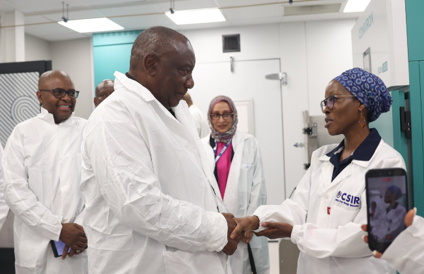
President Cyril Ramaphosa on Wednesday launched the Council for Scientific and Industrial Research (CSIR) FuturePHARMA facility in Tshwane. He described the launch as a significant step towards strengthening South Africa’s pharmaceutical capabilities and advancing the country’s health sovereignty.
The President officiated the unveiling and ribbon-cutting ceremony at the CSIR Campus in Waterkloof before taking part in a guided walkthrough of the facility.
During the walkthrough, President Ramaphosa was taken through key areas of the facility and received demonstrations of its advanced pharmaceutical development technologies and specialised capabilities.
“It is a pleasure to be here today for the launch of the FuturePHARMA facility. This is truly a milestone in South Africa’s journey towards health sovereignty,” President Ramaphosa said.
FuturePHARMA is an open-access pharmaceutical innovation and manufacturing facility that provides specialised infrastructure and expertise to researchers, innovators and industry partners working to develop pharmaceutical technologies, including active pharmaceutical ingredients (APIs).
The facility is intended to help bridge the gap between laboratory research and the development, scale-up and commercialisation of pharmaceutical technologies, while supporting technology transfer and skills development.
The President said the facility reflects government’s commitment to using science, technology and innovation to strengthen the country’s industrial capabilities, health security and long-term development.
“The FuturePHARMA facility signals our resolve as South Africa to harness science, technology and innovation in pursuit of sustainable development.
“It signals our resolve to grow our industrial capabilities and to achieve meaningful health security and sovereignty,” he said.
Lessons from COVID-19
President Ramaphosa said the COVID-19 pandemic had underscored the importance of countries developing their own scientific, technological and manufacturing capabilities.
The pandemic exposed vulnerabilities associated with dependence on global supply chains for critical health products, while demonstrating the close relationship between health security, economic resilience and national development.
“The COVID-19 pandemic taught us many lessons, chiefly that developing economy countries need to strengthen local scientific, technological and manufacturing capabilities if they are to safeguard the health of their people.
“The pandemic was a reminder that health security, economic resilience and national development are interconnected,” he said.
Against this backdrop, FuturePHARMA is intended to create a more connected ecosystem linking research and technology development with process development, clinical development, regulation, manufacturing, investment and procurement.
From laboratory research to commercialisation
The President’s guided tour of the facility provided an opportunity to see these capabilities in operation, with scientists, researchers, engineers and technical specialists demonstrating key aspects of the pharmaceutical development platforms.
“It has been quite an experience to tour the facility and witness first-hand the advanced technologies, pharmaceutical development platforms and specialised capabilities that have been established here.
“I have had the opportunity to engage with the many scientists, researchers, engineers and technical specialists whose expertise and commitment have helped bring this vision to life,” the President said.
President Ramaphosa said South Africa has a strong history of scientific achievement and possesses significant scientific and innovative talent.
However, he noted that scientific excellence needs to be matched by mechanisms that allow promising ideas and discoveries to progress beyond the laboratory.
“Yet, scientific excellence alone is not enough. Too many promising innovations struggle to move from the laboratory into further development, commercial production and broader social application. That is the challenge FuturePHARMA has been established to help address,” he said.
The facility will provide specialised infrastructure for pharmaceutical process development, scale-up and technology transfer, occupying an important space between laboratory research and commercial manufacturing.
It is also intended to help promising technologies move towards clinical, regulatory and commercial pathways.
President Ramaphosa emphasised that FuturePHARMA is not intended to operate as a conventional commercial pharmaceutical manufacturing facility.
Instead, its value lies in providing shared infrastructure and expertise that may otherwise be too specialised or costly for individual researchers, universities and emerging companies to establish independently.
“By making these capabilities available to a broader community, FuturePHARMA can strengthen the connection between research, technology development, scale-up and manufacturing,” he said.
Government collaboration critical
The President said the success of FuturePHARMA would depend on strong partnerships between government, universities, research councils, industry, regulators, investors and other stakeholders.
He stressed the need for government departments and institutions to work together because the pharmaceutical value chain cuts across several mandates.
The Department of Science, Technology and Innovation has the responsibility of research, innovation, technology development, skills and strategic research infrastructure, while the Department of Health leads on health priorities, medicines and vaccines.
The Department of Trade, Industry and Competition plays a central role in industrial development, localisation, investment and manufacturing, while National Treasury is important to public financing and sustainability.
Regulatory institutions, including the South African Health Products Regulatory Authority, are also critical to ensuring pharmaceutical products can move through appropriate regulatory pathways.
“Our strategies, investments and programmes must reinforce each other,” President Ramaphosa said.
He said initiatives such as the emerging Pharmaceutical Roadmap and the Vaccine Innovation and Manufacturing Strategy should connect South Africa’s research and technology capabilities to national health priorities, industrial opportunities and market demand.
“We are building a connected system in which each institution and investment contributes to a common national objective,” he said.
Strengthening the African pharmaceutical value chain
President Ramaphosa said South Africa’s ambitions extended beyond its borders, noting the emphasis placed by the African Union and the Africa Centres for Disease Control and Prevention on local manufacturing as part of the continent’s health security and sovereignty agenda.
He said South Africa is well positioned to contribute to regional pharmaceutical value chains through its research institutions, universities, regulatory capabilities and manufacturing capacity.
“FuturePHARMA supports this ambition by creating opportunities for collaboration with African researchers, institutions and companies,” he said.
The facility will form part of a broader network of investments aimed at strengthening South Africa’s pharmaceutical development, health innovation and manufacturing capabilities.
President Ramaphosa said established manufacturers and companies would continue to play an important role, with facilities such as FuturePHARMA and manufacturers such as Biovac contributing different capabilities across the broader pharmaceutical value chain.
Investing in skills, innovation and jobs
The President said investment in infrastructure must be accompanied by investment in people, partnerships and institutions.
FuturePHARMA is expected to contribute to skills development, while creating opportunities for researchers, innovators and companies to take technologies further along the development pipeline.
“Through FuturePHARMA, South Africa is investing not only in infrastructure but in knowledge, innovation and industrial capability.
“We are investing in the partnerships, skills and institutions that will allow that infrastructure to create lasting value for the nation and the continent,” the President said.
President Ramaphosa said creating pathways from research and innovation to technologies, enterprises, products and industries is important to advancing inclusive growth and employment.
He said government remains committed to creating an enabling environment through investment in strategic research infrastructure, human capability and stronger links between research and industry.
“This facility stands as a symbol of what can be achieved when government, academia and industry come together in pursuit of a common purpose,” he said.
President Ramaphosa congratulated the CSIR, its scientists and technical teams, as well as the partners involved in establishing FuturePHARMA.
“May this facility become a platform where South African knowledge is translated into technologies, where technologies become products, and where products create lasting social, industrial and economic value – both for South Africa and for our continent,” the President said. – SAnews.gov.za


