


In the year marking 30 years since the adoption of the Constitution; 50 years since the 1976 Youth Uprising; 70 years since the 1956 Women’s March and 60 years since the forced removals in District Six - government is engaging communities across the country to celebrate the gains, achievements and milestones of 32 years of democracy.
“Today’s launch forms part of the wider rollout of the Milestones of Freedom campaign, which was launched by President Cyril Ramaphosa in June this year,” Deputy Minister in the Presidency responsible for the Government Communication and Information System (GCIS), Kenny Morolong said.
Speaking at the provincial launch of the Milestones of Freedom campaign at the uMfolozi TVET College in KwaZulu-Natal on Thursday, Morolong said the first provincial launch took place in Sharpeville, Gauteng, in July 2026, where the GCIS, together with provincial government structures, hosted a memorial lecture marking the 30th anniversary of South Africa’s Constitution.
The Milestones of Freedom campaign is being commemorated through a year-long programme under the theme: “Honouring the Past. Delivering the Future.” The campaign seeks to promote social cohesion, inspire national pride and encourage reflection on South Africa's democratic journey by highlighting key milestones the country is commemorating this year.
The Deputy Minister said South Africa has recorded many achievements since attaining democracy in 1994.
“The 30-Year Review Report of South Africa’s Democracy (1994–2024), supported by the findings of Census 2022, reminds us that our country has recorded many achievements since 1994 that have uplifted our nation.
“These achievements also reflect the four areas or milestones we are commemorating this year, beginning with the adoption of the Constitution.
“The Constitution enshrines equality, human dignity and freedom from discrimination, laying the foundation for one of the world’s most progressive legal frameworks. It remains the cornerstone of our democracy and ensures that all laws align with the values and spirit of our democratic order,” the Deputy Minister explained.
This as South Africa’s Constitution is respected across the world for its commitment to human rights, judicial independence and accountable governance.
He said that Former Associate Justice of the United States Supreme Court, Ruth Bader Ginsburg, praised the Constitution as a modern and carefully crafted charter of governance, noting its deliberate commitment to protecting fundamental human rights and securing an independent judiciary.
“Its promise has been affirmed through landmark court decisions that have protected fundamental rights, advanced equality and strengthened our democracy. These include the prohibition of capital punishment and the advancement of equality for women and LGBTQ+ (lesbian, gay, bisexual, transgender, queer or questioning, intersex, asexual, and more) persons,” he said.
Morolong explained that a defining feature of the constitutional order is the separation of powers between the Executive, Legislature and Judiciary, which ensures that each branch exercises oversight over the others, reinforcing accountability and the rule of law.
“This framework is further strengthened by the Chapter 9 institutions, which play an indispensable role in protecting democracy, promoting good governance, and providing independent mechanisms through which citizens can seek redress and hold public institutions accountable.
“The courts and Chapter 9 institutions have over the years helped defend the rights of vulnerable and marginalised communities. South Africa has also held seven successful national and provincial elections, reaffirming the legitimacy and resilience of our democratic system,” he said.
The democratic gains have supported efforts to improve people’s quality of life through wider access to education, healthcare, housing, clean water, electricity, roads, social protection, and improved wages.
“According to the 2025 General Household Survey, access to improved sanitation increased from 61,7% in 2002 to 84,0% in 2025, while electricity access increased from 76,7% to 90,6%.
“Households with piped municipal water increased from 9.2 million in 2004 to 15.4 million in 2024, and 84,1% of households lived in formal dwellings in 2024.
“Social protection has also expanded, with the percentage of individuals benefiting from social grants increasing from 12,8% in 2003 to 39,5% in 2025,” the Deputy Minister said.
Honouring Chief Luthuli
The gathering was also attended by the family of prominent anti-apartheid activist, Chief Albert Luthuli.
“Chief Albert Luthuli taught us that we must not live only for ourselves but for other people. He always said that when we reach out to those who have less than us, that is where we find true joy. As we look around today and see the development in this community, we are grateful that his legacy continues to make a difference,” Luthuli's daughter-in-law, Veli Luthuli, said.
Speaking on behalf of the family, she further added that the activist was an exceptional communicator.
“He was also an exceptional communicator and strategist who knew how to unite and inspire people, and his message remains relevant today,” she said.
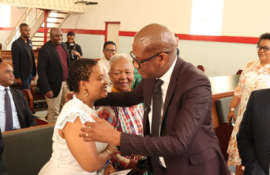
The day’s programme began with a wreath-laying ceremony at the Groutville United Congregational Church of Southern Africa, where Deputy Minister Morolong, joined by members of the Luthuli family, as well as provincial and local leadership, paid tribute to Chief Albert Luthuli.
The Milestones of Freedom Campaign was launched at the Union Buildings on 18 June 2026.
Earlier this week, the GCIS said it had begun rolling out the campaign to provinces. The campaign is also being launched today in the John Taolo Gaetsewe District, in the Northern Cape. - SAnews.gov.za


