


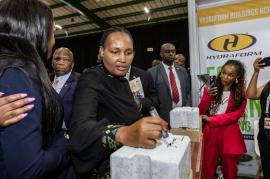
Human Settlements Minister Thembi Simelane has called for a fundamental shift in how South Africa plans, finances and delivers housing.
The Minister said traditional construction methods are no longer sufficient to meet the country’s growing and increasingly complex housing needs.
Delivering the keynote address at the first Presidential Innovative Building Technologies (IBT) Summit at the Nasrec Expo Centre in Johannesburg on Tuesday, Simelane described the gathering as a turning point in the country’s approach to human settlements delivery.
“This summit marks a seismic shift. It is not a conference about ideas alone, [nor] an exhibition of technologies for admiration. The character of this summit is anchored on an important clarion call to decisive action [and] a collective commitment to change how we plan, finance, approve and build sustainable human settlements in our country,” Simelane said.
She said while government had made significant strides since 1994, delivering more than five million housing opportunities in the form of sites and houses, the country continued to face a stubborn housing backlog of about 2.5 million households.
Simelane highlighted rapid urbanisation and population growth, pressure on land and infrastructure, constrained public finances and the escalating climate crisis as structural challenges that demand new solutions.
“Section 26 of our Constitution affirms that everyone has the right to have access to adequate housing. The way we have been building is no longer sufficient for the scale, speed, and complexity of South Africa’s housing challenges,” the Minister said.
She noted that urbanisation is reshaping the global landscape of human life and South Africa is urbanising rapidly, with projections indicating that nearly 70% of the population will live in urban areas by 2050.
This growth, she said, often manifests in informal settlements located on floodplains, unstable slopes and environmentally degraded land, placing the poorest households directly in harm’s way.
At the same time, climate change has become an undeniable reality, with the country already experiencing devastating floods, prolonged droughts, extreme heat, and destructive fires.
“The built environment is both a contributor to carbon emissions and a frontline of vulnerability. Housing must be reimagined not just as shelter, but as climate-resilient infrastructure, energy-efficient assets, water-wise systems, and engines of green economic growth,” she said, adding that IBT offer a practical pathway to achieving these goals.
Read I Tech innovations key to building climate-resilient homes - President Ramaphosa
In the South African context, IBTs refer to building systems developed outside conventional brick-and-mortar methods and certified through Agrément South Africa in terms of the National Building Regulations and Building Standards Act.
These include, among others, panelised and modular systems, lightweight steel framing, alternative foundation technologies, and prefabricated or off-site manufactured components.
Simelane stressed that these technologies are not experimental curiosities but proven viable construction solutions capable of delivering faster build times, predictable quality, reduced material waste, and improved energy performance, often at lower lifecycle costs.
The Minister said the mainstreaming of IBTs is firmly grounded in government policy. The 2024 White Paper on Human Settlements, approved by Cabinet, commits the state to invest in innovative and flexible building typologies; promote sustainable and resilient materials; strengthen partnerships with the private sector, academia and civil society; and enable rapid responses through alternative building technologies.
In support of this policy direction, Simelane announced that the department will finalise Performance-Based National Norms and Standards for IBTs, guided by outcomes of the summit.
These standards will allow IBTs to be integrated into subsidised housing programmes, provide regulatory certainty to industry and financiers; protect consumers through minimum performance requirements; and ensure safety, durability, energy efficiency and accessibility.
However, the Minister warned that innovation must be approached honestly, noting concerns around local manufacturing capacity, skills availability, job impacts, financing models, and market acceptance.
Central to the summit, she said, is the development of a Social Compact on Mainstreaming Innovative Building Technologies, bringing together government, regulators, the private sector and developers, financial institutions, academia and research councils, and civil society and community formations. – SAnews.gov.za


