


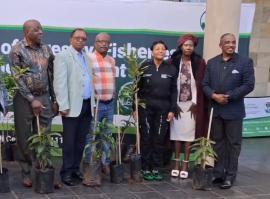
Deputy Minister of Forestry, Fisheries and the Environment Bernice Swarts says stronger cooperation between government, traditional leaders and communities is essential to improving service delivery and advancing development in the Ehlanzeni District Municipality in Mpumalanga.
Swarts was addressing stakeholders during a District Development Model oversight visit to the district on Monday, where she emphasised the importance of coordinated governance guided by the National Development Plan 2030.
The District Development Model (DDM) was introduced to improve how government plans, budgets and delivers services by promoting a unified approach across all spheres of government.
“The DDM encourages us to work as ‘One Government, One Plan, One Budget’ ensuring that communities receive services more efficiently and that development happens in a coherent and inclusive manner,” Swarts said.
According to the Deputy Minister, the model seeks to align national, provincial and local government planning while strengthening collaboration with traditional leaders, civil society, the private sector and communities.
She said the DDM also serves as a mechanism for implementing the goals of the National Development Plan by enabling integrated planning at district level, coordinated investment across government spheres and stronger alignment between national goals and local realities.
Swarts noted that as District Champion for the Ehlanzeni District Municipality, her responsibilities include ensuring alignment of planning, budgeting and implementation across government, supporting the development and monitoring of the district’s One Plan, and addressing service delivery challenges.
The One Plan is a single, integrated development plan for a district that aligns the priorities, budgets and projects of national, provincial and local government, together with stakeholders, to coordinate service delivery and development in that area.
Swarts highlighted the important role of traditional leaders in the district’s development processes, saying Amakhosi are central partners in both the District Development Model and municipal Integrated Development Plans.
Traditional leaders provide community leadership and guidance, contribute indigenous knowledge on land use and environmental management, help strengthen social cohesion and assist in identifying local priorities such as infrastructure needs and service delivery gaps.
“They also play a key role in unlocking land for development, supporting local economic development initiatives and guiding community-based projects,” Swarts said.
She noted that during Phase II of the District Development Model, the district had made encouraging progress, including improved coordination of service delivery projects, better alignment of sector programmes with the One Plan and stronger stakeholder forums and intergovernmental structures.
However, she said several challenges remain, including infrastructure backlogs in key service areas and municipal financial constraints.
The upcoming Ehlanzeni District Municipal Investment Indaba, scheduled for 12 to 13 March, is expected to help unlock new investment opportunities and support efforts to address socio-economic pressures affecting households in the district.
The council-approved Phase III One Plan for the district focuses on strengthening integrated planning and budgeting, improving coordination across government and stakeholders, enhancing partnerships with the private sector and supporting opportunities for local small business development.
Other priorities include implementing and monitoring catalytic projects contained in the One Plan and ensuring that youth, women and persons with disabilities are prioritised in development interventions.
The District Development Model and the National Development Plan provide a framework for building capable, inclusive and resilient communities through collaboration between government, traditional leaders, communities and private partners. – SAnews.gov.za


