


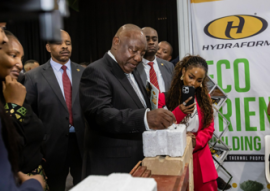
Traditional construction methods may no longer meet the needs of a growing population facing climate change and rising urban pressures, says President Cyril Ramaphosa.
Speaking at the Innovative Building Technologies (IBTs) Summit in Johannesburg on Tuesday, the President said while government has provided approximately five million housing opportunities since 1994, more remains to be done as the population expands, with an estimated 2.5 million families still on the waiting list.
“In the face of this, accelerating technological housing innovations is a social imperative and an economic necessity,” he said.
President Ramaphosa noted that by 2050, nearly eight out of every 10 South Africans are expected to live in cities - many in informal settlements on land vulnerable to floods, drought, heat stress, and environmental degradation.
“If we continue to build in the old way – on the same land, with the same vulnerabilities, using the same methods – then we are not solving the housing challenge. We must make a change. We must embrace the tide of technological progress to future-proof human settlements,” he urged.
The President cited inadequate supply, limited land availability, rising construction costs, and project delays as key contributors to housing scarcity. These pressures, he said, push prices and rents upward for the middle class, while worsening conditions for the poor, resulting in homelessness and expanding informal settlements.
“Having shelter that provides privacy, safety and freedom is inextricably bound to human dignity. Housing is not merely about shelter, but it is about belonging, security and opportunity,” Ramaphosa said.
The summit also focused on climate-resilient housing, particularly after recent floods in Limpopo claimed at least 25 lives and caused R4 billion in infrastructure damage. The President stressed that homes must be built to “protect lives, conserve resources and endure over time”, arguing that traditional construction alone is unsustainable.
“Innovative building technologies offer us a strategic opportunity. When appropriately regulated, financed, socially accepted and locally embedded, innovative building technologies allow us to build faster and at scale. They enable us to reduce carbon emissions and water use, improve energy efficiency, and enhance durability and quality,” he said.
Building together through a social compact
A key outcome of the summit is the Social Compact, aimed at taking innovative building technologies from pilot projects into mainstream use. Through the compact, government, banks, insurers, and development finance institutions have pledged to align funding, de-risk projects, and recognise IBT housing as financeable and insurable.
“Without this alignment, innovation stalls,” President Ramaphosa said.
Concluding his address, the President framed the summit as a call to action.
“Resilience is the difference between recovery and repeated loss, between dignity and displacement, between success and failure. We have the technology to build for the present and to be prepared for the future. Now we need leadership. We need partnerships.
“We need to be creative. We need to build faster and better. Let us work together to build a resilient, inclusive South Africa which is a home to all our people, and in which all our people have a decent home.” – SAnews.gov.za


