


The Love Your Street campaign arrived in Thembisa this week - not merely with cleaning material and refuse bags, but with a broader message: safe, clean public spaces are a shared responsibility and in communities scarred by violence, they can also be a matter of life and death.
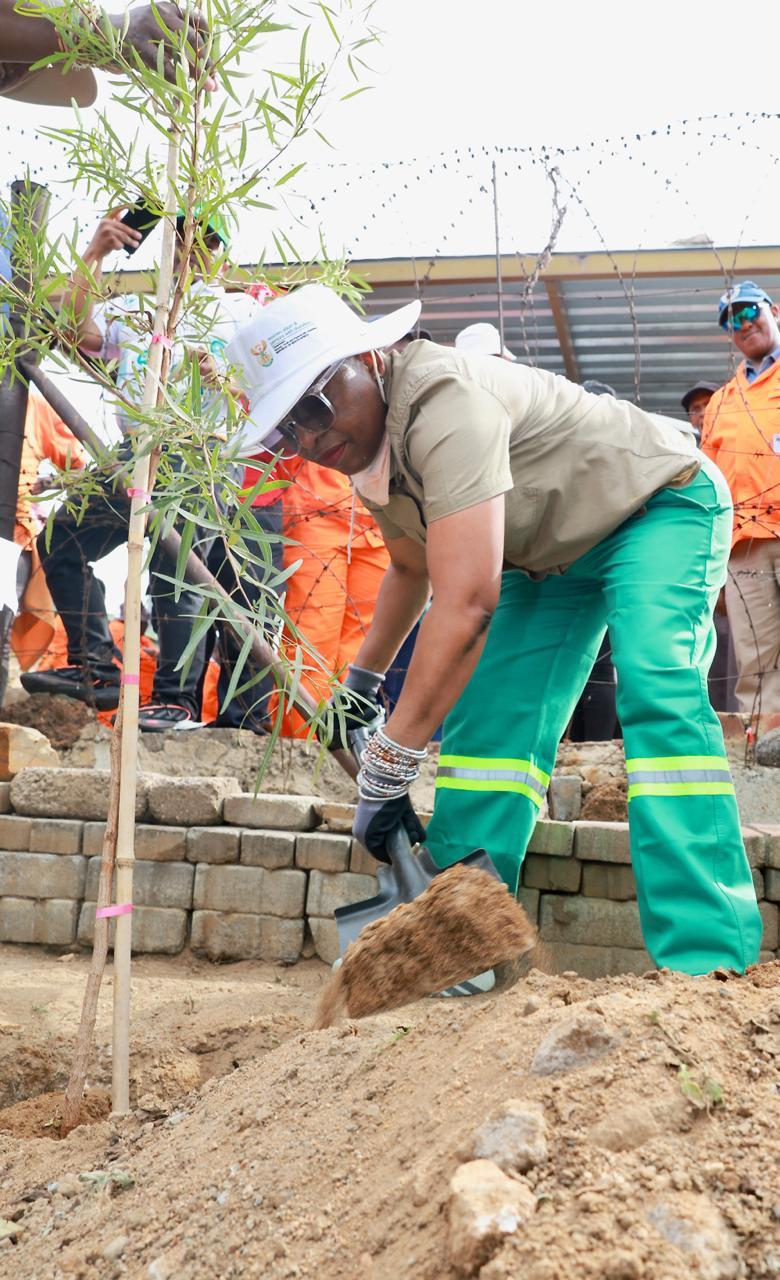
Minister in The Presidency Khumbudzo Ntshavheni, together with a delegation of government officials, civil society organisations and community members, rolled up her sleeves for the latest leg of the campaign aimed at improving cleanliness in neighbourhoods and community safety.
But, while the immediate task was clearing overgrown grass and picking up litter, the programme itself is part of a far larger government drive to strengthen partnerships between communities and municipalities, encourage active citizenship and reclaim neglected public spaces.
Launched earlier this year by The Presidency and the Government Communication and Information System (GCIS) in Mannenburg and Khayelitsha in the Western Cape, the Love Your Street campaign is being rolled out across provinces in collaboration with community structures, ward committees, community development workers, sector departments, ward councillors and constituency offices.
At its core, the campaign encourages residents to take collective responsibility for the spaces in which they live.
“The initiative forms part of government’s ongoing efforts to strengthen partnerships between communities and municipalities in addressing local service delivery challenges and improving the quality of life of residents.
“The campaign encourages residents to take collective responsibility for the spaces in which they live by participating in cleaning activities, preventing illegal dumping, clearing overgrown grass and maintaining public spaces. It also promotes a culture of community pride, environmental responsibility and active citizenship,” the GCIS said.
In Thembisa, those words took physical form as cleaning activities were conducted at an open space next to Thembisa South Police Station, a site chosen deliberately to send a message about safety and visibility.
“During the programme in Thembisa, cleaning activities were conducted at an open space next to Thembisa South Police Station.
“The activities highlighted the importance of reclaiming neglected public spaces and ensuring that communities can use these areas in a clean, safe and welcoming environment,” the GCIS explained.
Shared responsibility
For Ntshavheni, the campaign is about forging a new compact between residents and local government.
At the Thembisa clean-up, she stressed that cleanliness cannot be outsourced to the municipality alone.
“It’s all our responsibility. At Brand South Africa we say: ‘Everyone must play their part’.
“To the municipality, we are saying that you have the responsibility to debush overgrown areas and to also make sure that there are streetlights. The streetlights do not have to use great amounts of electricity; they can use solar electricity. Make sure that the environment is safe, and it’s fully lit for women and children to be able to walk about safely,” she stated.
Ntshavheni also addressed the challenge of illegal dumping, encouraging residents to wait for the municipality’s weekly refuse removal service rather than dumping waste in open spaces.
“If your refuse bags are full, don’t dump them illegally. Wait for the municipality to come and pick up the refuse weekly because we want to keep our cities clean.
“The municipality has a refuse removal service, which is weekly. It doesn’t mean when your refuse is full, you go and dump somewhere. You wait for the municipality to come and collect.
“This is not only a call to the municipality. We are here to solicit a partnership with communities to [curb] illegal dumping,” the Minister urged.
The GCIS echoed that call.
“The campaign calls on residents to work alongside local government in identifying challenges affecting their neighbourhoods and taking practical steps to improve their surroundings,” the department noted.
Confronting GBVF through environmental design
The visit to Thembisa carried a sombre, serious weight as the area was the site of the recent discovery of the bodies of several women and this marked the Minister’s second visit in three weeks.
The shadow of that violence, which shocked South Africans, added urgency to the campaign’s focus on safe, well-lit and clean public spaces.
Ntshavheni linked the campaign directly to the national fight against gender-based violence and femicide (GBVF).
“This is supporting the effort of the IMC against GBVF in the country - because part of the programme they have adopted as part of the National Strategic Plan against GBVF - is ‘safety by environmental design’, meaning that we should be safe because our streets are safe and also clean,” she said.
The Minister noted that the women who were found dead had largely been discovered in illegal dumping sites, with some bodies in advanced stages of decomposition.
The GCIS said the Love Your Street campaign forms part of a broader effort to transform spaces that have become associated with danger.
“The initiative also supports government’s efforts to address Gender-Based Violence and Femicide, particularly in areas where neglected parks, poorly lit spaces and overgrown open areas may raise safety concerns for community members.
“Through the Love Your Street campaign, government seeks to transform these spaces into safer and more accessible areas while raising awareness about GBVF, reporting mechanisms and the support services available to survivors,” the department stated.
Ntshavheni said the cleaning of the area around Thembisa South Police Station was meant to signal that police stations should be safe spaces for women and communities.
“We’re cleaning the area within the vicinity of the police station, and then we’ll go to the illegal dumping site because we have a clear fight against illegal dumping sites...[given that] terrible things happen there, and we want to encourage the communities not to dump illegally,” she said.
Beyond brooms: trees, towns and lasting change
The Love Your Street campaign is not only about refuse removal.
“The programme further builds on the Clean Cities and Towns campaign, launched by Deputy President Paul Mashatile in 2025, which calls for stronger cooperation between municipalities and communities to improve cleanliness and address environmental challenges in cities and townships.
“In addition, the Love Your Street campaign supports the Presidential One Billion Trees Planting Campaign, which promotes tree planting, greening, environmental sustainability, climate resilience and community participation in protecting the environment,” the GCIS said.
Ntshavheni said tree planting was about more than beautification.
“We are also planting trees because [the department has] a commitment of planting 1 billion trees, as tasked by the President.
“But, those trees are not just [planted] for their own sake. They are trees that show we want to have places where we gather; places that are safe and we want an environment and air that is clean,” she said.
The Minister also pointed to schools as key partners in instilling a culture of cleanliness and pride.
“Where I come from in the district of Vhembe, our schools have vegetable gardens. It doesn’t matter what [learners are] studying but they learn to feed themselves and to use the environment to feed themselves.
“They also run competitions of ‘the most beautiful flower gardens’. We want to work with the Ekurhuleni Municipality to make sure that we also get to that stage,” she said.
The campaign also highlights the role of collaboration across sectors.
“The involvement of community organisations and other stakeholders, including the MDDA [Media Development and Diversity Agency], also highlights the importance of collaboration across different sectors in supporting government initiatives that seek to improve the lives of South Africans.
“The campaign reinforces the principle that service delivery is a shared responsibility requiring the active involvement of government, municipalities, businesses, community organisations and residents.
“Through initiatives such as these, government aims to encourage communities to take ownership of their neighbourhoods, protect public infrastructure, maintain clean surroundings and contribute to safer, healthier and more sustainable settlements,” the GCIS said.
As the brooms were packed away and the refuse bags collected, the challenge now is to sustain the momentum beyond a single campaign day.
“Residents are encouraged to sustain the momentum beyond campaign activities by keeping their streets clean, reporting service delivery challenges and working with local authorities and community structures to maintain public spaces,” the GCIS said.
For Ntshavheni, the equation is simple: “When it’s clean, it’s also safe. When it’s safe, it’s conducive for women and children to thrive”. – SAnews.gov.za


