


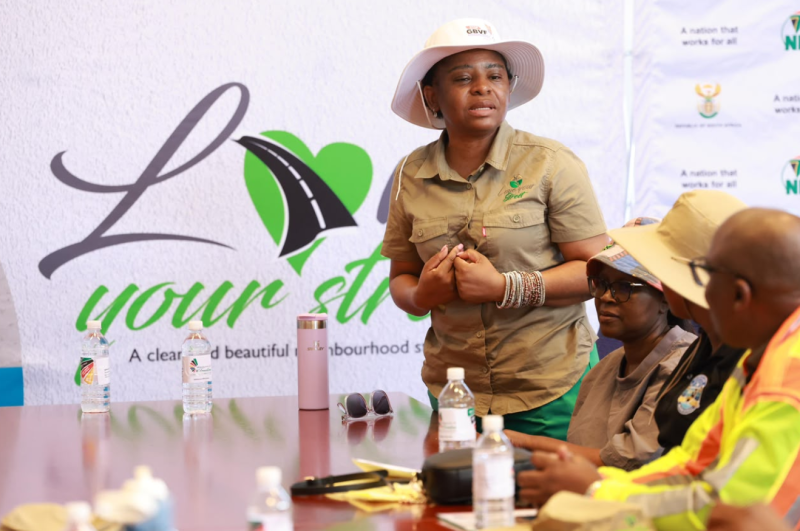
With brooms in hand and refuse bags at the ready, Minister in The Presidency Khumbudzo Ntshavheni has kicked off the latest event of the Love Your Street service delivery programme in Thembisa, in the Ekurhuleni Municipality.
The Minister - together with a delegation of government officials, civil society organisations and community members - rolled up her sleeves for the campaign aimed at improving cleanliness in neighbourhoods and community safety.
“It’s all our responsibility. At Brand SA we say: 'Everyone must play their part'. To the municipality, we are saying that you have the responsibility to debush overgrown areas [trees and shrubs] and to also make sure that there are streetlights. The streetlights do not have to use great amounts of electricity; they can use solar electricity.
"Make sure that the environment is safe, and it’s fully lit for women and children to be able to walk about safely,” the Minister said.
Ntshavheni addressed the prevalence of illegal dumping in the area, noting that cleanliness is a collective responsibility.
“If your refuse bags are full, don’t dump them illegally. Wait for the municipality to come and pick up the refuse weekly because we want to keep our cities clean ... The municipality has a refuse removal service, which is weekly. It doesn’t mean when your refuse is full, you go and dump somewhere. You wait for the municipality to come and collect.
“This is not only a call to the municipality. We are here to solicit a partnership with communities to [curb] illegal dumping,” she said.
Keeping women safe
The visit to Thembisa, in the Ekurhuleni Municipality, the site of the recent discovery of the bodies of several women, marks the Minister’s second visit to the area in the past three weeks.
The shadow of that violence gives added impetus to the campaign’s message of safe, well-lit and clean public spaces.
READ | Ntshavheni leads Love Your Street campaign in Ekurhuleni
“This is supporting the effort of the IMC [Inter-Ministerial Committee] against GBVF [gender-based violence and femicide] in the country, because part of the programme they have adopted - as part of the National Strategic Plan against GBVF - is 'safety by environmental design', meaning that we should be safe because our streets are safe and also clean.
“The women who were found [dead] - the majority of them were found in illegal dumping sites and some of their bodies were also in advanced stages of decomposition,” Ntshavheni noted.
Love Your Street campaigners cleaned the area next to the Thembisa South Police Station.
“We want to make sure that the police station is deemed as a safe space for women and for communities.
“We’re cleaning the area within the vicinity of the police station, and then we’ll go to the illegal dumping site because we have a clear fight against illegal dumping sites ... [given that] terrible things happen there, and we want to encourage the communities not to dump illegally,” Ntshavheni said.
About the Love Your Street Campaign
The campaign was launched by The Presidency and the Government Communication and Information System (GCIS) in the Western Cape earlier this year.
“The Love Your Street campaign forms part of government’s ongoing efforts to promote community pride, active citizenry, and clean and safe neighbourhoods," the GCIS said in a statement.
“The campaign builds on initiatives such as the Clean Cities and Towns campaign, launched by Deputy President Paul Mashatile in 2025. It promotes partnerships between communities and municipalities to help keep cities and townships clean, including addressing illegal dumping and the problem of overgrown greenery.
“The Love Your Street campaign accelerates and strengthens effective, integrated service delivery interventions, including gender-based violence and femicide [GBVF] awareness by transforming neglected, poorly lit, overgrown parks and open spaces, identified as GBVF hotspots, into safe, clean community spaces, while educating community members about GBVF reporting mechanisms and available services,” the GCIS explained.
Tree planting and teaching
The Love Your Street campaign also accelerates the Presidential 1 Billion Trees planting campaign, which promotes a collaborative and inclusive approach to environmental sustainability, greening, climate resilience and community participation across all communities.
READ | One Billion Trees campaign improves lives, empowers communities
“We acknowledge the contribution of the Department of Forestry, Fisheries and the Environment [DFFE] … and as part of [the campaign], we are also planting trees because [the department has] a commitment of planting 1 billion trees, as tasked by the President.
“But, those trees are not just [planted] for their own sake. They are trees that show we want to have places where we gather; places that are safe and we want an environment and air that is clean,” Ntshavheni said.
Honing in on schools, the Minister emphasised that places of learning have a role to play to ensure that learners are taught to clean their own environments and keep their areas clean.
“Where I come from in the district of Vhembe, our schools have vegetable gardens. It doesn’t matter what [learners are] studying but they learn to feed themselves and to use the environment to feed themselves. They also run competitions of 'the most beautiful flower gardens'. We want to work with the Ekurhuleni Municipality to make sure that we also get to that stage.
“In the Department of Cooperative Governance and Traditional Affairs, there’s a programme they run, together with the DFFE, about the cleanest towns in the country, clean cities and clean streets. That’s what we want to get our country to be - the cleanest place because when it's clean, it's also safe. When it’s safe, it’s conducive for women and children to thrive,” Ntshavheni said. – SAnews.gov.za


