


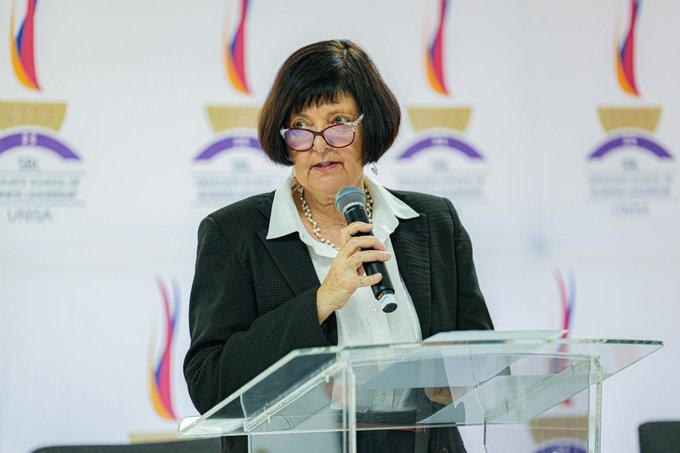
As geopolitical pressures drive up household costs, Transport Minister Barbara Creecy says government is advancing an integrated transport system designed to make public transport safer and more affordable.
“This year has been a difficult one for households, bus and taxi operators, and the broader freight and logistics industry. Our geopolitical environment is not of our choosing. Its impact on supply chains, trade routes and the fuel price is there for all to see. From our side, we are doing everything in our power to make public transport more affordable,” the Minister said.
Speaking at the launch of Transport Month, which is observed in the month of October, Creecy said the recovery of passenger rail services by the Passenger Rail Agency of South Africa (PRASA) is providing commuters with an alternative mode of transport.
Creecy said PRASA had recovered 35 of its 40 priority passenger rail lines over the past two years, most recently restoring part of the Midway–Lenz route.
“PRASA passenger trips rose from 10 million in 2020/21, after the pandemic, to an audited figure of 101 million at the end of the 2025/26 financial year.
“On average, a Prasa passenger pays between R12 and R15 for a return trip at peak hours, depending on the distance travelled,” the Minister said.
This year, PRASA will continue refurbishing tracks, signalling systems and stations to accommodate more passengers and provide services that are more frequent and punctual.
“The integration of passenger and road transport systems is central to improving affordability and safety for commuters. Bus and minibus taxis remain central to our transport system.
“We are in the process of reforming our public transport grant system into a unified support model available on selected routes to bus and taxi operators alike. Our reform is guided by foundational principles including integration, sustainability, fairness, safety and commuter affordability. Consultation continues with all affected parties to develop a workable model,” the Minister said.
The Department of Transport is also working with the taxi industry to reform and formalise the sector through the following measures:
- Repurposing the taxi recapitalisation grant and reducing risk in the industry so that operators can buy more affordable vehicles with lower repayments; and
- Formalising and right-sizing the industry through pilot Transport Operating Companies - one in each province - to test new management and investment models.
Creecy launched Transport Month under the theme: “Building a safe, sustainable, reliable and affordable transport system”, marking 21 years since the inaugural October Transport Month in 2005.
Rail and ports
Last week, Cabinet supported the establishment of the Transnet National Ports Authority (TNPA) as a stand-alone, state-owned company, underscoring the central role of rail and port reform in government’s transport agenda.
The separation is intended to improve the operational performance, infrastructure reliability and competitiveness of South Africa’s freight and logistics system.
“As an independent company, TNPA will be able to use its revenue to invest in port infrastructure and equipment, thereby accelerating the journey, which has already seen three of South Africa’s ports tagged as most improved in a recent World Bank study,” Creecy said.
According to Creecy, the separation will be guided by several principles, including fair compensation for Transnet based on an independent valuation of TNPA, long-term financial sustainability, and the equitable allocation of liabilities between the Transnet Group and TNPA.
Other principles include protecting workers, jobs and customers; preserving strategic state ownership and control of national ports infrastructure; and improving the investment capacity and infrastructure development of both TNPA and Transnet.
Cabinet also approved a TNPA investigation into the feasibility of bringing in a minority equity partner from one of the country’s development finance institutions (DFIs).
Creecy said the 2022 White Paper on National Rail Policy and the 2023 National Freight Logistics Roadmap are beginning to deliver results.
The policies aim to attract private-sector funding for infrastructure development and reposition rail as the country’s transport backbone.
“In March, the Department approved eleven private Train Operating Companies (TOCs) to use the state-owned national rail network, bringing private expertise and capital into operations. Operations are due to begin in April 2027.
“In July, the Transnet Rail Infrastructure Manager published a second Network Statement, creating the necessary certainty to ensure the TOCs can secure rolling stock, staff and capital,” the Minister said.
Approved for public comment earlier this year, the Draft National Rail Master Plan sets out a vision for an interoperable, regulated and well-maintained state-owned railway network that will form the backbone of an integrated system for moving people and goods.
“Transnet’s 2025/26 results show rail volumes of about 167.9 million tonnes against a target of 180.6 million tonnes—progress towards our goal of 250 million tonnes a year on the Transnet network by the end of the political term,” the Minister said.
Creecy explained that increasing rail tonnage will require significant investment from both the state and the private sector.
Through the Budget Facility for Infrastructure, R16.8 billion in public investment has already been approved and is being deployed across the coal and iron ore lines and port infrastructure. Applications for a further R23.6 billion are being developed.
“On Monday 12 October we will invite you to the Northern Cape to view current rail upgrades to the iron ore line during the annual “shut”.
“Private-sector investment in the rail and port infrastructure is being facilitated through projects currently in the market for the Ngqura Manganese Export Corridor, Richards Bay Dry Bulk Terminal, and later this year the container corridor between Gauteng and Durban,” the Ministers said. -SAnews.gov.za


