


South Africa and Brazil must use their Strategic Partnership to advance a stronger Global South voice, reform the global financial architecture and ensure that critical minerals drive industrialisation and prosperity in their own economies.
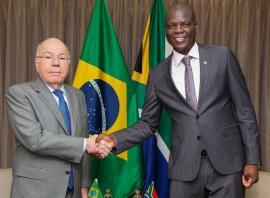
International Relations and Cooperation Minister Ronald Lamola urged this on Wednesday, while delivering opening remarks at the Eighth Session of the South Africa-Brazil Joint Commission in Pretoria, which he co-chairs with Brazil’s Minister of Foreign Affairs Mauro Vieira.
The Joint Commission is taking place against the backdrop of what Lamola described as strong headwinds facing the multilateral system and global peace, with the two countries facing an increasingly important role in defending multilateralism and advancing the interests of developing countries.
“Today, as the multilateral system and global peace face strong headwinds, our joint efforts are more important than ever,” Lamola said.
He said South Africa and Brazil, as two leading economies on their respective continents, were well positioned to act as bridge builders between the Global North and Global South.
“As two leading economies on our continents, Brazil and South Africa are bridge builders between the countries of the global North and the global South,” he said.
Lamola said the two countries had consistently pursued common positions in multilateral forums, particularly on reforming global governance to better reflect the aspirations of the majority of the international community.
He highlighted the urgent need to reform the global financial architecture, pointing to the burden of debt servicing across Africa and Latin America and the Caribbean.
“On our continent, as many as 750 million people, more than half of Africa’s population, live in countries that spend more on interest payments than on hospitals and classrooms.
“In Latin America and the Caribbean, many countries are also saddled with debt. More than half of the population, or roughly 350 million people, live in countries that spend more on debt repayments than on health,” he said.
Lamola said the two countries had used their membership of the G20 to highlight these inequalities and push for concrete reforms.
“As founding members of the G20, Brazil and South Africa have used the forum to place these imbalances under the microscope and to advance concrete reforms,” he said.
The Minister also identified critical minerals as an area where South Africa and Brazil could deepen cooperation and pursue a different development model for the Global South.
Both countries are rich in minerals needed for the transition to a green economy, with Lamola warning that growing global demand should not simply reproduce historical patterns in which developing countries export raw materials while value and wealth are created elsewhere.
“Our countries have not hesitated to use their voice and soft power to call attention to the challenges and crises bedevilling countries of the global South,” he said.
He added that South Africa and Brazil could work together to ensure that critical minerals contribute to industrialisation, skills development and technological advancement.
“Our countries are well placed to advance a different model – one in which the minerals that power a green future also power industrialisation, skills development, technological exchange and prosperity in our own societies,” he said.
The Joint Commission will also examine ways to strengthen bilateral economic ties and expand market access between the two countries.
Brazil is South Africa’s largest trading partner in Latin America, with bilateral trade amounting to approximately US$2 billion in 2025.
Lamola said South African companies had established a presence in Brazil in sectors including pharmaceuticals, technology, mining, financial services and chemicals, while Brazilian companies were investing in South Africa’s automotive and food-manufacturing sectors.
He said the African Continental Free Trade Area offered Brazilian companies access to a rapidly integrating African market of more than 1.4 billion people, while Brazil offered South African companies an important gateway into Latin America and the Caribbean.
The SACU-MERCOSUR Preferential Trade Agreement also provided a platform on which the two countries could build.
“This Joint Commission gives us an opportunity to explore ways to expand market access, address trade barriers, and ensure this partnership fulfils its true promise. South Africa is equally committed to achieving more balanced and diversified trade between our countries,” Lamola said.
The Minister said South Africa also looked forward to concluding the Agreement on Investment Promotion, Cooperation, Facilitation and Protection, which he said would strengthen the framework for productive and mutually beneficial investment.
The two countries are expected to review existing bilateral agreements and identify new areas of cooperation, including aggrotech, aerospace and defence industries, biopharmaceuticals, creative industries, critical minerals beneficiation, energy, science and innovation, youth and women’s empowerment, transport and health.
Lamola also highlighted growing tourism ties, noting that Brazil had become South Africa’s ninth-largest source market for tourism.
Nearly 65 000 Brazilians visited South Africa in 2025, with Lamola attributing the recovery towards pre-pandemic levels partly to the bilateral 90-day visa agreement and the expansion of direct flights between South Africa and São Paulo.
The Joint Commission follows President Cyril Ramaphosa’s State Visit to Brazil in March, during which the two countries reaffirmed their Strategic Partnership.
Lamola said the relationship was rooted not only in contemporary political and economic interests but also in a shared history of struggle against colonialism, slavery and racial exclusion.
He recalled that former President Nelson Mandela visited Brazil in August 1991, where he met political leaders, representatives of the Black movement and ordinary Brazilians to thank them for their solidarity with South Africa’s liberation struggle.
The Minister said the historical ties between the two countries continued to inform their contemporary partnership.
“Our histories and our difficult journeys towards building united and diverse societies have taught us important lessons. Democracy is always a work in progress.
“Democratic victories are never permanent. Democracy survives through vigilance, strong institutions and the active participation of citizens,” he said.
Against this backdrop, Lamola expressed confidence in the resilience of Brazil’s democracy as the country approaches its upcoming elections.
“It is in this spirit that we wish the people of Brazil well as they approach the upcoming elections. We are confident in the strength and resilience of Brazil’s democracy,” he said.
Lamola said South Africa viewed Brazil as a dependable ally in the pursuit of a more equitable international order.
“South Africa is proud to have in Brazil a dependable ally and co-creator of a just, democratic and equitable world,” he said.
The Eighth Session of the South Africa-Brazil Joint Commission will assess progress in existing areas of cooperation and identify new opportunities to deepen the Strategic Partnership. – SAnews.gov.za


