


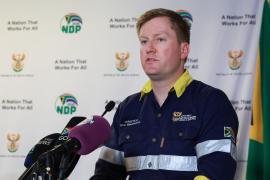
Public Works Minister Dean Macpherson says investigations into four building collapses, when considered together, point to recurring weaknesses across parts of the built-environment system.
“The principal problem identified by these investigations is inconsistent implementation, inadequate oversight, weak enforcement and non-compliance. At the same time, the reports identify areas in which the regulatory framework itself requires modernisation and strengthening,” the Minister said on Thursday, in Pretoria.
Macpherson was presenting the findings of investigations into four building and construction incidents that occurred in South Africa between December last year and March this year.
The investigations were commissioned against the backdrop of a deeply concerning period for building safety in the country.
The investigations followed serious incidents at Redcliffe in Verulam, eThekwini; Doornkop in Soweto; Ormonde in Johannesburg; and the Magnolia Development in Sea Point, Cape Town.
Across the four incidents, 17 people died, and 24 were injured.
“The second major finding is that significant unlawful construction can remain outside the formal regulatory system for far too long. Redcliffe and Ormonde are the clearest examples.
“In both cases, substantial construction had progressed without prior building approval. The investigations also raise concerns about the wider practice of construction proceeding first and approval being sought afterwards. That is unacceptable,” the Minister said.
He stressed that building approval is not unnecessary red tape.
“It is a public-safety control. The purpose of obtaining approval before construction is precisely to allow the relevant authority to consider whether what is proposed complies with the law before people are exposed to risk.
“A system in which substantial construction can proceed and only afterwards be regularised fundamentally weakens that protection,” Macpherson said.
The third finding concerns what happens after approval has been granted and construction has commenced.
“The reports identify an excessive regulatory focus on the initial building-plan approval stage. Building control cannot stop when a plan receives a stamp. Authorities need visibility over what happens during construction. They need to know when construction has commenced,” the Minister said.
The fourth finding relates to municipal capacity and capability.
“The investigations raise concerns about shortages of suitably qualified building-control personnel, limited inspection capacity and the ability of municipalities to identify construction which has never entered the approval system,” he said.
Macpherson cautioned against generalising across all municipalities, saying the findings show materially different circumstances among the municipalities involved.
“The reports therefore recommend that the affected municipalities assess and strengthen their building-control capacity and enforcement systems,” the Minister said.
The fifth major issue is professional competence and accountability.
“The investigations raise concerns about inadequate supervision, failures to discharge statutory responsibilities and weaknesses in verifying whether people accepting responsibility for specialised or high-risk work have the required competence.
“The sixth finding is that our regulators do not share enough information with one another. Lastly, the finding raised concerns about consequence management.
“Where owners, developers, contractors or professionals deliberately ignore statutory requirements, penalties must provide a real deterrent,” the Minister said.
The reports recommend strengthening sanctions for violations of planning and construction requirements.
“Taken together, these are not four isolated lessons. They reinforce weaknesses that Government has now seen emerge across successive structural incidents.
“One of the important recommendations emerging from these investigations is that Government needs to become better at detecting risk before a collapse occurs,” Macpherson said.
He added that repeated building collapses point to deeper structural issues that must be urgently reviewed in order to improve building safety and construction oversight.
“As we work to turn South Africa into a construction site, it is critical that we do so in an environment where building construction can be trusted and the loss of life avoided.
“Increasing the pace and scale of construction cannot come at the expense of safety. In fact, the more we build, the more important effective building control, competent professionals, proper construction management and strong enforcement become,” the Minister said. -SAnews.gov.za


