


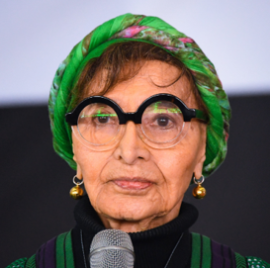
Seventy years after 18-year-old Sophie de Bruyn helped lead 20 000 protestors to the seat of apartheid power, she returned to the very steps of the Union Buildings, which were once a symbol of racial and gender subjugation, to urge a new generation of women to rise against the contemporary plagues of gender-based violence, corruption and systemic inequality.
In her address to the commemoration of the 70th anniversary of the historic 1956 Women’s March, de Bruyn spoke of how the women marched, not without fear, but with determination and courage to confront the brutal apartheid government.
“The joy of that solidarity, the triumph of knowing that we could break the back of oppression is a fire that still burns deep within me even today.
“We emerged from the darkness with a firm belief that our daughters, our children would walk in absolute freedom from the triple yolk of oppression as a race, class and gender which we experienced under apartheid,” de Bruyn said on Sunday.
This as the National Women’s Day commemoration took place at the Union Buildings in Pretoria.
She noted that today, the women of South Africa face different challenges, including gender-based violence (GBV) and the knock-on effects of corruption, adding that freedom now is a “painful paradox…our present realities are so deeply disappointing and distressful”.
“We fought to banish the pass laws, yet today our women are prisoners in their own homes. Gender-based violence continues to cast a dark cloud on our society. And every single day I weep for the girl child, the daughters, the mothers and grandmothers who are abused, violated and silenced.
“And yet, even when these clouds [gather], my spirit refuses to break and give up. And my happiness comes back from looking at you, the women of today. You are still the rock; you are still resilient.
She added that despite the struggles, women continue to hold families and communities together.
“Your courage is the beacon of hope and the light that keeps this country moving forward,” de Bruyn emphasised.
She challenged authorities to “not let our sacrifices be in vain” through eradicating corruption and protecting women and children.
Furthermore, leaders are urged to “have a moral compass and backbone and match the bravery of 1956 with bold, honest and accountable leadership”.
“To the ordinary citizens of our country, in particular women, do not give up hope. Your vote, your voice and your unity are your critical weapons. We handed you a free country. It is now up to you to make it a safe and prosperous one. Let us march forward once more, not against pass laws.
“But this time against crime and insecurity, poverty, corruption, unemployment, homelessness, violence and the many ills that restrict your future, your safety, your freedom and your prosperity.
“To the young women, do not wait for anyone’s permission. Stand up, use your voice and fight for your future, fight against poverty and abuse. Just like we fought against apartheid, and together let us finish the march we began 70 years ago. Let the spirit of the 1956 rise again in each of your hearts,” de Bruyn urged.
Courage
Speaking at the commemoration, Nobel Peace Laureate Malala Yousafzai, who survived being shot in the face for advocating for girls’ schooling, praised the courage displayed not only by the 1956 marchers but also by the generations that followed.
“It took incredible courage to speak out in 1956, four decades before the end of apartheid. The risks were greatest for black South African women, as they still are today. They faced not only the racial discrimination of apartheid but the added burdens of being women in a patriarchal society. Yet, they chose to lead and demanded to be seen.
“It is their legacy of courage that brings me back to South Africa today. I was honoured to be here three years ago. We have come not only to mark this historic anniversary but to learn from you, from elders like Madam Sophie [de Bruyn]. We want to learn how South Africans organised and how you endured generation after generation until the world had no choice but to listen,” Yousafzai said.
The two women spoke ahead of President Cyril Ramaphosa’s address under the theme: “Empowered Women, Empower Nations.”
The commemoration comes in a year that South Africa also commemorates the 30th anniversary of the adoption of the Constitution; the 50th anniversary of the 1976 youth uprisings; and the 60th anniversary of the forced removals from District Six.
Speaking at the launch of the Milestones of Freedom Campaign in June, President Ramaphosa urged the nation to build the South Africa of which our forebears dared to dream.
“As we launch the Milestones of Freedom, let us hold all four of these anniversaries in our hands at once: the women, the children and the dispossessed and the Constitution that turned their dreams into a promise of a better future.
“We are the inheritors of their courage. We are the keepers of their dream. And we are, every one of us, the authors of what South Africa will become. Let us, together, build the South Africa of which our forebears dared to dream, united in our diversity, equal in our dignity and free at last,” President Ramaphosa said at the time.– SAnews.gov.za


