


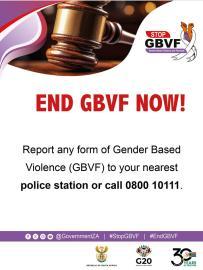
The Intergovernmental Committee on Disaster Management (ICDM) is urging the nation to take action and encouraging all citizens to participate in educational and awareness campaigns aimed at ending gender-based violence and femicide (GBVF).
The Minister of Cooperative Governance and Traditional Affairs (CoGTA), Velenkosini Hlabisa, who serves as the Chairperson of the ICDM, convened a special extended meeting on Monday to address the issue of GBV, following its recent classification as a disaster.
For many years, South Africa has faced the deeply entrenched crisis of violence against women and children.
Despite sustained interventions by government and civil society, the department said the effects of this pervasive brutality continue to reverberate across communities nationwide.
Hlabisa welcomed and reaffirmed the critical significance of the President’s announcement, classifying GBVF as a national disaster.
The classification of GBVF as a National Disaster on 21 November 2025, under Section 23 of the Disaster Management Act, 2002 (Act No. 57 of 2002), signifies a crucial turning point and serves as a catalyst for extensive, coordinated action.
“This classification stands as an urgent reminder that every sector of society must converge, intensify cooperation, and adopt bold, transformative measures to confront GBVF.
“It underscores that incremental approaches are no longer tenable and calls upon all stakeholders to mobilise resources to safeguard vulnerable and affected groups,” the statement read.
The ICDM reiterated that government alone cannot resolve this deeply rooted societal scourge.
The meeting highlighted the imperative of collective mobilisation across all spheres – state institutions, civil society formations, traditional structures, and communities.
“If executed with rigour and coherence, this classification has the potential to significantly enhance national efforts and drive meaningful, measurable impact.”
A report from the Department of Women, Youth, and Persons with Disabilities (DWYPD) emphasised the necessity for collaborative action, highlighting that this crisis demands a comprehensive approach from both the government and society.
“The presentation stressed the urgent need to fully implement the National Strategic Plan on GBVF, together with other key policies aimed at deterring perpetrators and ensuring consequences for those who continue to harm vulnerable groups,” the statement read.
The ICDM called for intensified impact in identified hotspots and highlighted the importance of partnerships that will help uncover all cases, including those that go unreported.
According to the department, the committee will continue to monitor progress closely to ensure that the disaster classification translates into tangible improvements in communities.
The ICDM further urged all national organs of state and stakeholders to work together to eradicate GBVF.
The meeting reiterated that without active community involvement, the fight against GBVF cannot succeed.
”We are all affected and impacted. It is in our hands to put a stop to GBVF.”
This call comes at the right time as South Africa begins the 16 Days of Activism for No Violence against Women and Children Campaign. – SAnews.gov.za


