


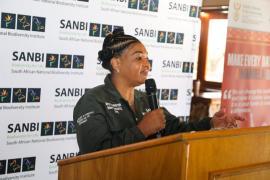
Deputy Minister of Forestry, Fisheries and the Environment Bernice Swarts has called on South Africans to participate in the celebration of International Nelson Mandela Day by taking action and donating time, knowledge or resources to a community organisation.
“Every act of kindness matters. Every act of service counts. Every tree planted contributes to a larger movement of hope and restoration,” the Deputy Minister said on Friday.
She was leading the commemoration of International Nelson Mandela Day at the National Botanical Gardens in Pretoria under the theme: “Planting Hope, Growing Resilience: 67 Minutes for People, Nature and Climate Action.”
The initiative forms part of a global tree-planting relay spanning continents and demonstrating that environmental stewardship knows no borders, and that each of us has a role to play in building a greener, more sustainable future for generations to come.
“A restored landscape can support livelihoods and food security. A tree nursery can create employment. A protected wetland can provide clean water and reduce the impacts of floods. A safe public park can strengthen social cohesion and give children a place to learn, play and grow,” the Deputy Minister said.
Swarts emphasised that greening communities is therefore not simply about making places beautiful.
“It is about justice. It is about ensuring that every child, regardless of where they live, can enjoy clean air, shade, safe public spaces and a healthy environment.
“It is about addressing the environmental inequalities created by our history and ensuring that no community is left behind as we respond to climate change. When we plant trees in schools, clinics, parks, townships, informal settlements and rural villages, we are investing in dignity, health and equality,” the Deputy Minister said.
Mandela Day is an annual global celebration, officially recognised by the United Nations, which takes place on 18 July to honour the life and legacy of Nelson Mandela.
The day is a call to action for individuals, communities and organisations to reflect on Mandela’s values and principles and to take meaningful steps to make a positive impact in their own communities.
“As we dedicate our 67 minutes today, let us remember that the greatest tribute we can offer Nelson Mandela is not simply to speak about his legacy, but to live it. Madiba’s legacy calls on us to choose courage over indifference, service over self-interest and solidarity over division.
“It calls on us to recognise that poverty cannot be separated from inequality, and inequality cannot be separated from the condition of the places in which people live,” Swarts said.
She said Nelson Mandela showed us that change remains possible even when the challenges before us appear overwhelming.
“The challenges of poverty, inequity, climate change and environmental degradation are significant. But they are not beyond our ability to address.
“They are in the hands of young people who are determined to create a better future. As we leave here today, let us not plant trees only for photographs or ceremonies. Let us plant trees that will be protected, nurtured and allowed to grow.
“Let us plant not only trees, but also the seeds of dignity, opportunity, equality and lasting change. There is a well-known saying that the best time to plant a tree was many years ago. The second-best time is today. Let us plant hope, grow resilience and build communities in which both people and nature can thrive,” the Deputy Minister said.
Swarts said climate change, biodiversity loss, pollution and environmental degradation affect us all, but they do not affect everyone equally.
“Poor and vulnerable communities are often the first to experience the consequences of floods, droughts, extreme heat, water shortages, food insecurity and the degradation of natural resources,” she said.
The Deputy Minister said many rural communities depend directly on healthy ecosystems for food, water, grazing, medicinal plants and income.
“When rivers become polluted, wetlands disappear, forests are cleared, and land becomes degraded, these communities lose more than natural resources. They lose livelihoods, security and opportunities for development.
“In our cities, poorer communities frequently have fewer trees, fewer parks and fewer safe green spaces. They are more exposed to extreme heat, polluted air and environmental hazards,” she said. -SAnews.gov.za


