


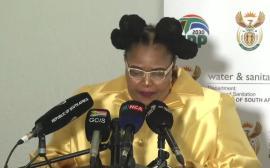
The Minister of Water and Sanitation, Pemmy Majodina, has announced the establishment of a national Water Sector Anti-Corruption Forum as part of intensified efforts to combat crime, corruption and sabotage within South Africa’s water sector.
Presenting the department’s Budget Vote in Parliament on Friday, Majodina identified water mafias - organised criminal networks engaged in crime, corruption and sabotage of water infrastructure - as one of the central threats to water service delivery.
“One of the focus areas on the National Water Action Plan is the fight against crime and corruption in the water sector. The Forum involves law enforcement, government, the private sector and civil society, and is coordinating efforts to prevent, detect, investigate, and respond to corruption within the sector,” Majodina said.
Launched on 5 March 2026, in partnership with the Special Investigating Unit (SIU), the Forum will coordinate a multi-stakeholder response to corruption.
Rural access programme
The Minister also announced that the department has initiated a nationwide programme to accelerate access to water services for unserved communities, many of which are in rural areas.
The programme seeks to implement rapid, cost-effective, and appropriate interventions such as groundwater development, spring protection and rainwater harvesting, in addition to extensions of existing water supply systems.
Majodina noted that substantial work has been done to identify communities and potential water sources where there is no formal potable water infrastructure or where existing systems are non-functional. To date, over 2 600 settlements without reliable potable water have been identified.
“We are now packaging a number of projects, prioritising grant funding, mobilising our Water Boards, the private sector and civil society, including through the Adopt-a-Village approach, to accelerate implementation,” Majodina said.
In the Eastern Cape, 14 borehole projects are currently being implemented across 16 communities, with a further eight spring protection initiatives underway in partnership with the Department of Agriculture. In KwaZulu-Natal, 28 boreholes and two spring protection projects are in progress.
Addressing water services challenges in metros
Majodina said the department is supporting broader institutional and governance reforms within the water sector, including support for Metro Trading Service reforms and technical guidance on ringfencing municipal water services as sustainable trading functions.
Key infrastructure projects include the upgrade of the Klipdrift Water Treatment Works in Hammanskraal, under the City of Tshwane Metropolitan Municipality, and the Welbedacht Pipeline in Mangaung Metropolitan Municipality.
“For the Welbedacht pipeline, Phase 1 was completed in June 2025 at a cost of R585 million, improving water supply reliability to Mangaung. In Phase 2, a 71-km expansion, estimated at R1.6 billion, is in advanced planning, with implementation scheduled from 2027 to 2032,” Majodina said.
Building skills and capacity in the sector
In addressing capacity constraints within the sector, Majodina revealed that while the department’s overall vacancy rate stood at 6.79% as of March 2026, critical engineering and scientific posts had a higher vacancy rate of 15.8%.
Over the past financial year, 116 technical positions were filled, alongside the appointment of 54 candidate engineers and scientists.
She added that the department’s Learning Academy continues to play a key role in building future capacity, with partnerships across the water sector and private industry to provide training and mentorship.
Since its inception, she said the academy has awarded bursaries to more than 1 000 young people, many of whom have gone on to join the department.
“The Learning Academy currently has 226 external bursars contracted to the department from all the mainstream universities. The bursars are studying in the scientific, engineering, construction and project management fields,” she said.
Global relationships
On the global stage, South Africa is playing a leading role in the African Union’s Africa Investments Programme, which was established by the United Nations High Level Panel on Water.
The Minister noted that the African Union’s Africa Investment Programme finalised a report, which highlighted the need for increasing investment in the water sector through mobilisation between R10 billion and R12 billion annually.
“This led to the United Nations appointing South Africa and France to prepare and co-chair a theme on investment in water for the 2026 United Nations Water Conference, which will be co-hosted by the United Arab Emirates and Senegal in December 2026,” the Minister reported.
The investment theme is one of six themes of the UN Water Conference, each of which will be co-chaired by two Member States. – SAnews.gov.za


