


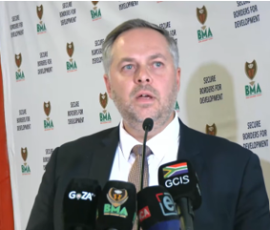
Home Affairs Minister Dr Leon Schreiber says the department has expanded access to Smart ID replacement services by 47% within two months through its new digital partnership with banks.
The Minister said there are plans to roll the service out to at least 750 bank branches by the end of 2026.
Delivering the Home Affairs Budget Vote in the National Assembly on Friday, Schreiber said the digitalisation of the long-standing partnership between Home Affairs and the banking sector is already changing how citizens access critical services.
“After only eight weeks, a total of 167 bank branches across the length and breadth of South Africa now offer Smart ID replacement services, with more branches going live every week,” the Minister said.
He said the application process has been fully digitalised, allowing citizens to apply for IDs in as little as five minutes without bookings or paperwork.
“Gone are the days of spending a whole day in a queue. At these 167 bank branches, it now takes as little as five minutes to apply for an ID. No prior bookings are required. No paperwork is needed. And there is no official discretion, completely sealing the system off from manipulation and fraud by relying on the power of biometric technology,” Schreiber said.
According to the Minister, 118 434 Smart ID applications have already been processed through the new system for people replacing lost cards or switching from the Green ID book.
He said the project is key to migrating the estimated 16 million South Africans still using Green ID books to Smart IDs.
“The Green ID is the most defrauded document on the African continent and sits at the heart of financial fraud and identity theft in our country,” he said.
Schreiber also announced that first-time Smart ID and passport applications will soon be introduced through the banking platform, alongside a new doorstep delivery service.
“And we will introduce doorstep delivery of IDs and passports for the first time in South African history.
“Thanks to our laser focus on digital transformation, South Africans will shortly have the option of having their enabling document securely couriered right to their own doorstep, without the need to travel anywhere just to do a collection,” he said.
ETA system blocks nearly 4 500 illegitimate travellers
Schreiber said the department’s Electronic Travel Authorisation (ETA) system has already processed more than 75 000 applications since being introduced for tourists from China, India, Mexico and Indonesia ahead of the G20 Leaders’ Summit last year.
The ETA allows travellers to apply for visas through smartphones or laptops and receive outcomes within 24 hours.
“This new system uses biometric and machine learning technology to enable prospective travellers to apply for a tourist visa on their laptop or smartphone and receive their visa within just 24 hours,” Schreiber said.
He explained that the system checks 40 parameters to verify passport authenticity and uses facial recognition and liveness detection technology to strengthen border security.
“Even with the rollout initially limited to just four countries, I can report today that the ETA has already processed over 75 000 applications, resulting in more than 71 000 approvals and nearly 4 500 rejections.
“Think about that for a moment. That’s almost 4 500 people who were prevented by the ETA from obtaining a visa, who may otherwise have entered our country illegitimately under the old manual and paper-based system.”
The Minister said the system will soon be expanded to more countries and eventually cover all visa categories.
Draft Digital ID regulations published for public comment
Schreiber announced that draft regulations for the department’s new Digital Identity system have been published for public comment until 6 June 2026.
READ | Have your say on digital identity draft regulations
The Digital ID forms part of the Home Affairs @ home programme and is expected to enable citizens to securely access Home Affairs services remotely through their smartphones.
“For our third flagship reform, Digital ID, we have recently published draft regulations in terms of the Identification Act.
“I invite all stakeholders to comment on these draft regulations before the closing date of 6 June, so that we can implement an appropriate and fit-for-purpose regulatory framework for this new system that will enable South Africans to securely access Home Affairs services in the palm of their own hand,” he said.
The Minister said the reforms are being supported by a digital training programme aimed at preparing thousands of officials for the future world of work.
Crackdown on corruption
Schreiber said corruption-related dismissals, arrests and convictions are now taking place at a “near-weekly basis” across the department and the Border Management Authority (BMA).
He told Parliament that since the start of the current administration, the Department of Home Affairs has secured 10 criminal convictions, 14 arrests and 65 dismissals, while the Border Management Authority has secured an additional 26 arrests and 34 dismissals.
“We are now carrying out dismissals, arrests and convictions on a near-weekly basis. Crooked officials are no longer asking whether they will be caught.
“They are spending all their time wondering when it will be their turn. My answer to them is simple: sooner than you think,” he said.
Schreiber said the department will continue rooting out corruption while intensifying immigration enforcement operations.
He said Home Affairs conducted 10 700 enforcement inspections during the past financial year under Operation New Broom, exceeding its annual target of 4 000 inspections.
“Over the past two financial years, Home Affairs has carried out nearly 110 000 deportations – an increase of 46% compared to previous years.
“This is in addition to the over 945 000 people that the BMA has prevented from entering into South Africa, either illegally or because they did not have the required documentation, since its establishment.”
R12.5 billion investment planned for border infrastructure
The Minister also announced that the Border Management Authority has selected bidders for a R12.5 billion public-private partnership to rebuild South Africa’s six busiest land ports of entry.
“Last month, the BMA announced the bidders that have been selected for a R12.5 billion public-private partnership to demolish and rebuild our country’s six busiest land ports of entry,” he said.
Schreiber said Cabinet has also approved the Revised White Paper on Citizenship, Immigration and Refugee Protection, which introduces the first-safe-country principle aimed at preventing asylum seekers from bypassing other safe countries to seek refuge in South Africa.
“By implementing the Revised White Paper, we will introduce the first-safe-country-principle to end the practice of asylum seekers ‘picking and choosing’ South Africa as their only destination in the region,” he said.
The Minister said the reforms were strengthened by a recent Constitutional Court judgment confirming that asylum seekers cannot submit endless repeat applications after their original applications are rejected.
IEC receives additional R1.1 billion for elections
Schreiber said the Home Affairs Budget Vote includes an additional R1.1 billion allocation for the Independent Electoral Commission (IEC) to prepare for the upcoming local government elections.
“The national voter registration campaign will officially launch on 27 May 2026 under the message: ‘Get Up, Show Up, Vote,’” he said.
He added that more than 6 100 field workers have already been deployed across five provinces to assist with registration activities in municipalities affected by ward delimitation and voting district changes.
The elections will be held on 4 November 2026.
The Home Affairs budget totals R13.8 billion for the 2026/27 financial year, R12.8 billion for 2027/28, and R13.3 billion for 2028/29. – SAnews.gov.za


