


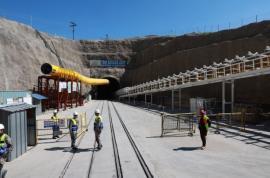
Water and Sanitation Minister Pemmy Majodina, Deputy Minister David Mahlobo, and Lesotho’s Minister of Natural Resources, Mohlomi Moleko, are set to unveil state-of-the-art equipment today at the Polihali Construction Site in Mokhotlong, Lesotho.
The event marks the launch of the second Tunnel Boring Machine (TBM), a significant milestone in Phase II of the Lesotho Highlands Water Project (LHWP).
The development signals the transition from preparatory work to full-scale tunnelling along one of Southern Africa’s most ambitious water transfer routes.
The first TBM was commissioned at Katse Dam in February 2025 and has started tunnel drilling at the Katse site.
Each machine measures approximately 423 metres in length and is equipped with a 5.38-metre cutterhead, designed to operate continuously under challenging underground conditions.
The two TBMs will excavate through the Maluti Mountains from opposite ends, ultimately connecting the Polihali and Katse reservoirs via a 38.5km tunnel.
Water and Sanitation spokesperson, Wisane Mavasa, said during the process, the machine will also install precast concrete lining segments, seamlessly transforming raw rock into a completed structure in one uninterrupted process.
“Once completed, the Polihali Tunnel will facilitate the transfer of significantly larger volumes of water, thereby enhancing regional water security and bolstering hydropower generation in Lesotho,” Mavasa explained.
The Polihali Tunnel is one of the major components of LHWP Phase II, which is currently under construction.
Other major elements include a 165-metre-high concrete-faced rockfill dam at Polihali, located downstream of the confluence of the Khubelu and Senqu-Orange rivers, as well as the 800-metre-long Senqu Bridge.
Additional works include access roads, resettlement initiatives, and environmental, social, and public health programmes.
The LHWP aims to harness the Orange–Senqu River system through a network of dams and transfer tunnels to augment water supply to South Africa’s Integrated Vaal River System, which supports the country’s economic hub in Gauteng.
The project also contributes to hydropower generation in Lesotho.
Mavasa noted that the Polihali reservoir will have a storage capacity of approximately 2 322 million cubic metres.
Phase II is expected to progressively increase the current water supply rate by adding 490 million mᵌ/a to the existing 780 million cubic metres per annum (mᵌ/a) to 1 270 billion mᵌ/a transferred to South Africa. – SAnews.gov.za


