


Mokhotlong, Lesotho – Strong regional cooperation between South Africa and Lesotho has emerged as a defining feature of Phase II of the Lesotho Highlands Water Project, with government emphasising partnership as key to unlocking long-term water and economic security.
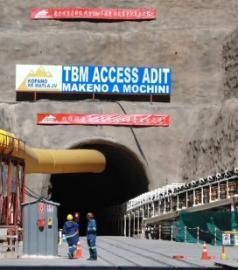
This comes as Minister of Water and Sanitation Pemmy Majodina, along with Deputy Minister David Mahlobo, conducted an oversight visit to the Polihali project site following the launch of the Tunnel Boring Machine (TBM) in Polihali, in the Kingdom of Lesotho, on Monday.
The dam construction site and tunnel, both located in the mountainous district of Mokhotlong, form part of a large-scale infrastructure programme aimed at boosting water supply to Gauteng while supporting hydropower generation in Lesotho.
Speaking to SAnews, Deputy Minister David Mahlobo said the project reflects strengthened governance and renewed cooperation between the two countries after years of delays.
He said the leadership of both ministers has helped stabilise the project, which had been delayed for nearly a decade, and placed it firmly back on track toward its 2028/29 water delivery target for South Africa.
Mahlobo highlighted regional collaboration as one of the project’s most significant outcomes and strengths, noting that shared water resources in Southern Africa are being used to promote peace and development rather than conflict.
He told SAnews that, unlike other parts of the world where water scarcity often leads to tensions, countries in the Southern African region are working together to ensure mutual benefit, with water serving as a tool for cooperation and shared growth.
“In other parts of the world, there is a bigger issue about shared water causes, and there are issues of conflict, and normally, women and children in other parts where there is conflict, water is being weaponised. But in this part of our region, SADC [Southern African Development Community], water is used for peace. Water is used for shared development,” the Deputy Minister said.
The Deputy Minister also pointed to the high level of engineering expertise involved in the project, describing it as a blend of South African, Basotho and international skills working in coordination under challenging mountainous conditions.
He said the scale and complexity of the tunnel stretching over 38 km underground demonstrate advanced engineering capability, with a diameter wide enough to accommodate large machinery and vehicles.
“The second component that we can look at is the quality of engineers that we have brought here, a number of the engineers are South African engineers, others are from here (Lesotho), there is cross pollination from international partners if you look at the contractors.
“You look at the kind of work that is being done on the terrain and the machinery that is here, it is a very complex kind of engineering that is used to go underground for a longer period of time,” Mahlobo told SANews.
Mahlobo further noted that the dam’s design incorporates flood management systems, including an off-channel spillway to manage excess water during periods of heavy rainfall, particularly in winter.
He said these features reflect forward planning and resilience in infrastructure design.
According to Mahlobo, the project is not only strengthening technical cooperation but also deepening diplomatic and economic ties between South Africa and Lesotho.
He said the partnership led by the two ministers and supported at the highest political level by President Cyril Ramaphosa, His Majesty King Letsie III, and Lesotho’s Prime Minister is elevating relations between the two nations.
Once completed, the Polihali Transfer Tunnel will significantly increase water transfer capacity to South Africa while boosting hydropower generation in Lesotho, reinforcing a model of regional integration built on shared resources and shared prosperity. – SAnews.gov.za


