


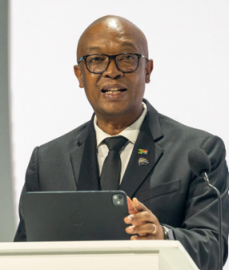
Trade, Industry and Competition Minister Parks Tau has reaffirmed South Africa’s position as a competitive global investment destination, declaring that the country has “turned a corner” despite a volatile global economic environment.
Addressing the closing session of the Sixth South Africa Investment Conference in Sandton on Tuesday, Tau told delegates that the country remains open for business, underpinned by policy certainty and a stable regulatory framework.
Quoting President Cyril Ramaphosa, Tau said investments in South Africa are secure and supported by safeguards that ensure long-term stability for investors.
The Minister acknowledged mounting global economic uncertainty, including rising protectionism and disruptions to multilateral trade systems, but said South Africa had responded with resilience rather than retreat.
“We have learned that complexity is not a reason for paralysis, but rather it is a prompt for action. When the status quo was upended in April 2025, many predicted a reckoning. The prognosis was steep. Tens of thousands of jobs in citrus, wine, and vehicle manufacturing in South Africa were said to be at risk.
“Economists estimated the tariff shock could shave off measurable points of growth. It was, in the parlance of the moment, a crisis. What happened instead? South Africa did not reach Armageddon, and instead, we demonstrated resilience,” Tau explained.
Trade strategy shifts amid global headwinds
Minister Tau highlighted the country’s “Butterfly Strategy”, which has seen South Africa pivot its trade focus toward high-growth markets across Africa, Asia, the Middle East, and Latin America.
Key interventions included the establishment of an Export Support Desk to assist affected exporters and accelerated trade negotiations with major economies such as China and Thailand.
READ | SA rises to meet investment opportunities
He pointed to the recently signed China-Africa Economic Partnership Agreement, which will grant South African exports duty-free access to a multi-trillion-rand consumer market from 1 May 2026.
South Africa has also strengthened ties with the European Union through the Clean Trade and Investment Partnership, described by Tau as a first-of-its-kind agreement positioning the country as a gateway to the continent.
In Africa, progress under the African Continental Free Trade Area is gaining momentum, with Tau noting increased export activity across several countries, including the Democratic Republic of Congo, Egypt, and Ethiopia.
Investment commitments translating into projects
Reflecting on the impact of the investment conference since its launch in 2018, the Minister said government has made significant strides in converting pledges into tangible economic activity.
More than 300 projects have been initiated, with 161 either completed or under construction. Over R600 billion in investment commitments have already been injected into the economy.
He cited flagship projects such as the Platreef Mine in Limpopo and BMW’s investment in electrifying its Rosslyn plant in Tshwane as evidence of progress in industrial development and job creation.
The Minister emphasised that all investment announcements to be made at this year’s conference are backed by confirmed funding and board-level approval, signalling increased credibility of the platform.
Diversification, decarbonisation and digitalisation
Looking ahead, Tau outlined three strategic pillars for South Africa’s next phase of growth: diversification, decarbonisation, and digitalisation.
He said these pillars are central to the country’s industrial policy and will guide efforts to modernise the economy and attract sustainable investment.
“This new investment cycle is the platform on which we declare our ambitions for the next phase of this work. Where we are going is organised around three interlocking pillars: Diversification, Decarbonisation, and Digitalisation - the organising principles of our industrial policy, each backed by concrete implementation.”
Tackling structural constraints
Despite the progress, Tau acknowledged persistent challenges, particularly regulatory delays that hinder investment.
To address these, government has established a Fusion Centre to fast-track project approvals and resolve bottlenecks in real time.
He also announced plans for an Omnibus Fast-tracking Act aimed at streamlining licensing processes, digitising permits and enabling faster visa approvals for scarce skills.
The Minister urged global investors to partner with South Africa, emphasising that the country’s track record speaks for itself.
“We are not asking you to take a leap of faith. We are inviting you to follow the evidence. Come and invest with us. Come and partner with us. And together, let us prosper,” the Minister said. – SAnews.gov.za


