


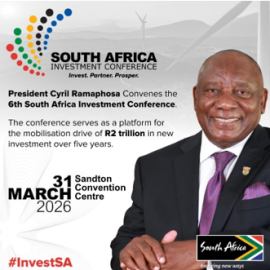
South Africa is choosing momentum over hesitation. At a time when global markets are marked by volatility and investor caution, the country is pressing ahead with its sixth Investment Conference - a signal that it intends not to retreat, but to compete.
On Tuesday, 31 March 2026, President Cyril Ramaphosa will convene the latest gathering in Johannesburg, positioning South Africa not just as the southern gateway to the continent, but as a resilient, reforming economy - actively making its case for global capital.
While South Africa is by no means sheltered from the heightened volatility in global energy markets arising from the tensions in the Middle East, the ongoing tensions involving the Gaza Strip and the Russia-Ukraine conflict, the conference is an important element on the South African calendar.
As more than 31 country representatives make their way to Mzansi for the conference, South Africa’s message to the world is clear: “South Africa is open for business and has entered a delivery-focused phase of economic reform.”
And that is not just a tagline, because, since the last investment conference held in 2023, work has been ongoing to realise the investment pledges made during the course of the five editions of the conference.
These pledges cut across various sectors, including energy, manufacturing and the automotive sector. Despite the two-year hiatus since the last conference was held, the spadework to bring the pledges into meaningful, real-life projects that advance the country’s development and improve citizens’ lives, has not stopped.
For example, mobility fintech company, Moove - which also operates in cities across Europe and India, amongst others, pledged R248 million of investment at the fifth conference held in April 2023. The funds were invested in the purchase of over 2 000 vehicles in Cape Town and Johannesburg. These vehicles were deployed to mobility entrepreneurs operating in these cities.
Meanwhile, the 2022 edition of the gathering saw German automaker BMW pledge R800 million. Just last July, President Ramaphosa attended the launch of the automaker’s new X3 plug-in hybrid model at its Rosslyn plant in Gauteng. South Africa is the exclusive global production site for this model. The last conference saw mobile communications company Vodacom pledge to invest in the global business services, ICT and digital services category. At the fifth conference, the company announced that it had pledged an additional R60 billion over the next five years. This came after it delivered on its promise to invest R50 billion over five years in 2018.
This time around, South Africa has set itself the target of raising R2 trillion in new investments over the next five years on the back of the R1.5 trillion raised over five years since the inaugural conference of 2018.
Despite the changing global landscape over the years, over R600 billion has flowed into projects, including new factories and mine facilities, that have been opened every year.
What this shows is that previous editions of the conference have not been once-off events but have produced concrete results as projects have been and continue to be followed through.
The hosting of the conference shows that the country is not tone-deaf to its own challenges and that investment by both domestic and international firms, plays an important role in addressing challenges that include poverty and unemployment.
While it is known that the country surpassed its initial R1.2 trillion investment target, South Africa has continued to put its house in order through reforms made possible by vehicles like Operation Vulindlela. Vulindlela is a joint initiative of the Presidency and National Treasury which aims to achieve more rapid and inclusive economic growth through a programme of far-reaching economic reform.
The country has also seen a 1.1% economic growth in 2025, following the recent release of the Gross Domestic Product (GDP) figures, which showed a 0.4% expansion in the fourth quarter of 2025.
The fact that the country officially exited the Financial Action Task Force (FATF) greylist after successfully implementing key reforms to combat money laundering and the financing of terrorism, in October 2025, also shows the progress the country is making.
Further progress was also evidenced in S&P Global Ratings’ (S&P) November 2025 move to bump up South Africa’s foreign currency long-term sovereign credit rating. At the time, National Treasury said the credit rating upgrade marked the first upgrade for South Africa by any of the major credit rating agencies in over 16 years.
While the quest for investments is important for our prosperity, prosperity does not mean that South Africa is heading down a protectionist path of only looking out for itself.
Investment in South Africa does not only translate to rands and cents and infrastructure development among others, but also comes with skills transfer, jobs and new technologies among others.
Given the country's strategic position on the continent, this will be helpful in advancing our contribution to the African Continental Free Trade Area (AfCFTA).
The free trade agreement seeks to bring together members of the African Union into a combined market. It establishes a framework for tariff liberalisation across the African continent and harmonises trade-related rules to encourage greater flows of intra-African trade and investment.
The South African Investment Conference has proven itself not to be a vehicle of broken promises but has proven itself to be an instrument that has brought tangible investment to a country that is not without its challenges, but working towards a brighter future. -SAnews.gov.za
Neo Semono is a Features Editor at SAnews.gov.za


