


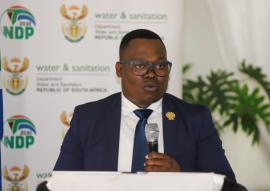
Water and Sanitation (DWS) Deputy Minister Sello Seitlholo has acknowledged progress made to improve water and sanitation infrastructure in the JB Marks Local Municipality in the North West.
He highlighted this during his two-day oversight visit in Potchefstroom and Ventersdorp on 26 to 27 March 2026, as he assessed the state of water and sanitation infrastructure in those areas.
The first day of the oversight visit began with a briefing on the state of water and sanitation in the municipality, followed by a series of site visits to assess ongoing infrastructure projects and areas affected by sewer spillages.
This was followed by a site visit to the Potchefstroom College of Agriculture, where a maintenance project is underway to address a bulk sewer pipeline that has been discharging raw sewage into the Mooi River.
“This was my second visit to the site since January this year, and it remains a priority due to the environmental risk it poses,” Seitlholo said.
The Deputy Minister noted that the bulk sewer pipeline at the college has deteriorated significantly and is in a state of progressive structural failure. The major challenge at the Potchefstroom College of Agriculture is that the pipeline has reached the end of its lifespan and is systematically collapsing.
“The pipeline requires full replacement rather than temporary repairs. I have therefore committed to engaging with the Department’s Water Services and the municipality to ensure that we provide the necessary support to resolve this matter permanently,” he said.
The oversight visits also included an inspection of the Ikageng Pump Station, which is currently undergoing refurbishment and upgrading, and once it is completed, the upgraded facility is expected to pump water at a rate of 400 litres per second and support improved supply to surrounding communities through the filling of the 25-megalitre reservoir in Extension 7.
Seitlholo welcomed the progress being made on the project but stressed the importance of seeing such infrastructure projects through to completion.
“It is important to acknowledge the good progress being made, but it is even more crucial to ensure that these projects are completed successfully and begin delivering real benefits to communities,” he said.
Concerns were also raised regarding the newly constructed Zakhele Sewer Pump Station; however, while acknowledging the necessity of the infrastructure, the Deputy Minister expressed reservations about its proximity to nearby households and the adequacy of security measures in place.
“Sanitation infrastructure should ideally be located at a reasonable distance from residential areas to minimise the impact on communities in the event of failures. I have also raised concerns about the adequacy of the current fencing, as insufficient security exposes the infrastructure to vandalism and theft, which remain major challenges in the water sector,” he said.
Further inspections were conducted at the Promosa bulk sewer pipeline upgrade project, which is intended to address long-standing sewer spillages that have resulted in pollution of the Poortjie Dam.
He noted that the progress on site was encouraging and expressed optimism that the project, once completed, would significantly reduce sewage spillages and improve environmental conditions in the area.
“Communities deserve to live in dignified environments with access to safe and reliable sanitation. I will continue to monitor the progress of these projects to ensure that pollution of our water resources is fully eliminated,” Seitlholo said.
On the second day of the oversight visit, the Deputy Minister travelled to Ventersdorp, where he engaged with community members and assessed the town’s persistent water supply challenges.
Focus was on Ventersdorp, particularly the Tshing area, which has been experiencing recurring water shortages for many years, resulting in widespread frustration among residents.
He indicated that Ventersdorp has been plagued by water supply challenges for a prolonged period, and residents have expressed feelings of neglect.
In some areas, water shortages have been experienced for more than a decade, and this is a matter that requires urgent and coordinated intervention.
“Ventersdorp is currently facing a significant gap between water demand and available supply. The demand for water in Ventersdorp is estimated at approximately 20 megalitres per day, while the current infrastructure is only able to supply between 5 and 6 megalitres per day, leaving a deficit of around 15 megalitres.
“This deficit means that while some areas may receive water, others remain without supply. The current infrastructure must not only be maintained but expanded to meet the needs of a growing population,” he said.
Water tankers
During his engagement with the community, the Deputy Minister also addressed concerns related to the provision of water using water tankers. He assured residents that the department would engage further with municipal leadership to address the matter and also accelerate interventions.
“I have asked the community to allow me time to engage with the municipal leadership and relevant officials so that we can establish the facts and return with clear feedback and solutions,” he said.
Multi-stakeholder engagement
Seitlholo further announced that he would convene a multi-stakeholder engagement involving national, provincial and municipal leadership to develop coordinated interventions for the area. This will include collaboration with senior officials from the Departments of Water and Sanitation and Cooperative Governance and Traditional Affairs.
“It is my responsibility to conduct oversight and ensure that the constitutional rights of citizens to access water and sanitation are upheld. We will therefore bring together all relevant stakeholders to ensure that sustainable solutions are implemented,” he said.
The Deputy Minister reaffirmed that the issues identified during the oversight visit will receive the necessary attention and that DWS will continue to provide updates.
“I want to assure communities that the concerns raised during this visit are being taken seriously and will receive the attention they deserve. Access to water is a basic human right, and we remain committed to ensuring that this right is progressively realised for all residents,” he said. – SAnews.gov.za


