


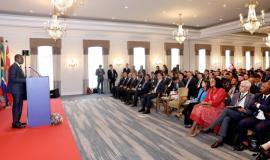
Deputy President Paul Mashatile has called for stronger economic cooperation between South Africa and China, urging increased investment in key sectors to support industrialisation, job creation and sustainable growth.
Speaking at the South Africa-China Economic and Trade Forum, held at the Mount Nelson Hotel in Cape Town, on Friday, Deputy President Mashatile said the partnership between the two countries continues to yield tangible economic benefits but requires further expansion to unlock its full potential.
“We firmly believe that this forum serves as a platform for aligning government strategies with private sector engagement.
“The issues discussed in our diplomatic and technical sessions are expected to be implemented by private sector players, leading to job creation, industrialisation, and shared prosperity. Central to this collaboration are opportunities that directly address our shared priorities,” Deputy President Mashatile said.
The forum followed the 9th Session of the Bi-National Commission, co-chaired by Deputy President Mashatile and his counterpart from the People’s Republic of China, Vice President Han Zheng, which reaffirmed the longstanding ties between the two nations built on mutual respect and shared development.
Deputy President Mashatile highlighted that China remains South Africa’s largest trading partner, with bilateral trade increasing by 6.4% from US$34.2 billion in 2024, to US$36.4 billion in 2025.
He said government efforts are now focused on restructuring trade patterns to promote value-added exports rather than raw commodities.
“Economic cooperation remains central to government collaboration. Efforts are focused on restructuring trade to enhance value-added exports to China,” he said.
He noted that Chinese investment in South Africa has reached US$8.11 billion across 103 foreign direct investment projects, creating more than 5 600 jobs. In turn, South African companies have invested US$689 million in China across sectors such as healthcare, ICT, manufacturing and financial services.
The Deputy President said the recently signed Framework Agreement for the China-Africa Economic Partnership Agreement (CAEPA) is expected to further enhance trade by lowering costs for Chinese imports of South African goods while improving market access for local industries.
He added that ongoing discussions around an Early Harvest Agreement could see certain South African exports receiving permanent zero-tariff treatment, subject to consultations within the customs union.
The Deputy President identified several priority sectors for investment, including mineral beneficiation, renewable and clean energy, ICT, agriculture, automotive manufacturing, and the hydrogen economy.
He emphasised the importance of moving beyond raw mineral exports by investing in processing and infrastructure development, adding that such efforts would help build sustainable industries and support long-term economic growth.
In the energy sector, the Deputy President said collaboration with China could accelerate South Africa’s transition to renewable energy, particularly in solar, wind and energy storage technologies.
He also highlighted the country’s potential to become a global leader in green hydrogen production, noting that South Africa’s natural resources position it as a low-cost producer of clean fuels.
“With strategic partnerships, we can lead the way into a new energy future, positioning our country as a global leader in clean fuels and sustainable industrialisation,” he said.
Deputy President Mashatile encouraged Chinese investors to take advantage of South Africa’s Special Economic Zones and industrial parks, which offer infrastructure, incentives and access to skilled labour.
He said South Africa offers political stability, a strong legal framework and world-class infrastructure, making it an attractive destination for investment and a gateway to the broader African market of 1.4 billion people.
He concluded by calling on both governments and the private sector to translate agreements into tangible outcomes that will drive inclusive growth.
“Let us take this moment to ensure that our collaboration not only brings prosperity to both our nations but also makes a meaningful contribution to Africa’s broader development agenda. Together, we can create a future defined by resilience, inclusivity, and shared success,” he said. – SAnews.gov.za


