


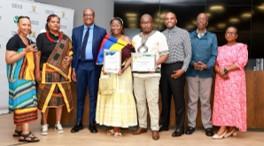
Deputy Minister in the Presidency Kenny Morolong has urged public servants to treat their roles not merely as a job, but as a calling to serve society.
The Deputy Minister delivered an address at the 2026 Government Communication and Information System (GCIS) Public Service Day commemoration, held in Pretoria, on Wednesday, 23 September 2026.
“Public service is more than a profession; it is a calling and a responsibility. It is a commitment to place the needs of our people at the centre of everything we do. Regardless of our role, we share a responsibility to contribute to the wellbeing, development and prosperity of South Africa.
“As we reflected last year, public service is not merely a job; it is a vocation rooted in the principles of Batho Pele, putting people first. Above all, we must never lose sight of who we serve and why we serve,” he said.
Public Service Month is recognised annually during September in South Africa.
“Public Service Month is not just a calendar event. It is both a celebration and a call to action. It recognises the contribution of public servants across the country while challenging us to continually improve the way we serve.
“It is a call to strengthen our performance and uphold the values of professionalism, integrity, accountability and compassion,” Morolong noted.
Turning to the unique mandate of the GCIS, Morolong highlighted that communication is inextricably linked to effective service delivery.
Citizens, he noted, can only fully access government opportunities and programs when they are empowered with “accurate, timely and relevant facts”.
“GCIS sits at the intersection of policy and the people it is meant to serve: the voice, the bridge and, at times, the first responder when citizens ask what government is doing, how it affects their lives and whether they can trust the message.
“Our responsibility is not simply to communicate, but to ensure that information reaches people in ways that are meaningful, accessible and useful.
“Every communication product, whether a media statement, community engagement, public information campaign or social media post, has the potential to help citizens make informed decisions and access opportunities that improve their lives,” he explained.
Morolong noted that with the Local Government Elections on the horizon (4 November 2026), the demands on government communicators will increase exponentially.
“During this period, citizens rely on government communication channels for information about services, programmes and government activities. It is therefore essential that we continue to provide information that is factual, accessible and responsive to the needs of the public.
“At the same time, we must remain mindful of an important principle that underpins our work: government communication must always be politically impartial,” he said.
The Deputy Minister urged all public servants within the GCIS to “take pride in what we have achieved while remaining focused on the work that lies ahead”.
“Let us continue to serve with professionalism, integrity and purpose. Let us continue striving for excellence in everything we do. And let us continue working together to build a stronger GCIS and a better South Africa.
“Together, we can ensure that government communication not only informs, but also strengthens democracy, promotes accountability and helps build a more united, inclusive and prosperous nation.
“In doing so, we carry forward the commitment we made last year: to ensure that no South African is left behind or left in the dark about what government is doing,” Morolong said.
Beyond the call of duty
Acting Deputy Director-General for Government Services Access and Improvement at the Department of Public Service and Administration (DPSA), Dr Patrick Sokhela, called on public servants to “go beyond the call of duty”.
“From our point of view, the whole year should be like today in terms of how as public servants value who we are and can then extend that to the citizens that you’re supposed to serve.
“What it means to me, we all have job descriptions, it’s about going beyond the call of duty, beyond the ordinary that you do [everyday]…then you go home and you come back the next day.
“It basically means that…we go out to those that are less privileged. Once one of the auditors have signed, it doesn’t mean that people have water. The books are signed but it does not or may not always translate to people having the services. That’s where you and me are coming in. Instead of going to the budget office or to your supervisor, you go and listen to people and say what are the gaps,” Sokhela said.
The Public Service Day at GCIS was celebrated with Heritage Month also in mind, as the country celebrates the latter in the month of September, as well.
Officials were dressed in their traditional garb, while exhibitors were also invited to show off their wares as well as render services.
Individual and team stand-out performances throughout the year were also celebrated with awards handed over to those public servants.
The spirit of service displayed by the GCIS, Sokhela said, is what the entire public service must tap into.
“In my report to cabinet, at the next cabinet committee [meeting] I will include this day and highlight the day that GCIS has convened and I would like to replicate the modus operandi and the spirit in which GCIS is taking this as a serious call to duty.
“I would like to take the spirit here; that it should be recognised and we should take it together throughout the country,” he said.
This spirit is demonstrated in the GCIS’ clean audit outcome for the year which was praised by Nathan Lawnet from the Office of the Auditor-General SA.
“From my experience it’s very easy to get a clean audit in the first year but it’s much more difficult to retain one. In order to retain a clean audit, you need to make sure that you’ve got a leadership that supports the environment, to make sure that they give the ethical tone that needs to be there, they act on finance management.
“You need to have a finance unit, an SCM (Supply Chain Management) unit and a user department that understands what’s their role. When they spend, they follow the rules, they spend within budget and when they report, they report timely and accurately,” he said.
Heritage Month
As Heritage Month is being celebrated in September, Mava Mothiba from the Department of Sports, Arts and Culture reminded GCIS officials that heritage is not static but the “dynamic ever changing daily lives that carry our heritage”.
“The practices, our languages, our indigenous medicines. These practices carry knowledge from generation to generations. We acknowledge that they have not been celebrated enough.
“When we look at heritage studies, a lot that has been produced is Eurocentric in terms of perspective. But we are making progress.
“I encourage everyone to look into their families, their communities to say: who are our living heritage figures who need to be interviewed? Be an active participant in preserving our heritage,” Mothiba said.
Beyond the festivities, a moment of silence was also held to honour and remember the victims of gender-based violence and femicide (GBVF), reinforcing government’s stance of standing together against the scourge. – SAnews.gov.za


