


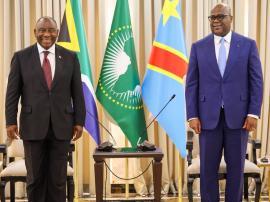
KINSHASA, DRC - President Cyril Ramaphosa has called for greater African solidarity, urgent humanitarian access and increased investment in African-led health innovation as the Democratic Republic of Congo (DRC) intensifies efforts to contain an Ebola outbreak that has claimed hundreds of lives.
Speaking during a multi-stakeholder engagement at the National Institute for Biomedical Research (INRB) in Kinshasa on Thursday, Ramaphosa, in his capacity as the African Union (AU) Champion for Pandemic Prevention, Preparedness and Response (PPPR), said Africa must strengthen its collective response to the outbreak while supporting the DRC's ongoing efforts to contain the disease.
The visit followed bilateral talks with DRC President Félix Tshisekedi before the two leaders toured the country's premier biomedical research facility, where scientists and health experts briefed them on ongoing response efforts.
"Earlier today, President Tshisekedi and I had an opportunity to discuss the ongoing Ebola outbreak and broader matters of regional health security,” Ramaphosa said.
He said the visit was not only part of his continental mandate but also reflected the longstanding relationship between South Africa and the DRC.
“Beyond the deep and enduring bilateral relationship between our two countries, we are here to express our solidarity with the government and people of the Democratic Republic of the Congo at this difficult time.
“On behalf of my government and the people of South Africa, we express our profound condolences to the Congolese people who have lost their loved ones and extend our sympathies to all who have been affected by the outbreak,” the President said.
Ramaphosa also paid tribute to frontline healthcare workers, scientists and humanitarian personnel leading the response.
“We also salute the healthcare workers, scientists, humanitarian personnel and community leaders who are working tirelessly on the frontlines,” he said.
The President stressed that Africa's response to health emergencies must continue to be driven by unity.
“The people of Africa are one. Our bonds transcend borders, ethnicity and language. When there is tragedy in one part of our beloved continent, we all share in the sorrow. When a sister country needs assistance, we answer that call,” he said.
Ramaphosa noted that African leaders had already mobilised substantial international support following a virtual summit convened by Burundi's President Évariste Ndayishimiye on 16 June.
“That meeting mobilised approximately 1.5 billion US dollars in financing, technical support, medical countermeasures and humanitarian response. It is significant that of this amount, over 100 million dollars was pledged by African countries themselves.
“This reflects the spirit of solidarity and cooperation we continue to see in pursuit of African health sovereignty,” he said.
However, he stressed that these commitments must now be translated into tangible action.
“Firstly, we need to rapidly convert the pledges made into financing, technical assistance and the deployment of urgently needed medical countermeasures,” he said.
Ramaphosa also called for humanitarian access to communities affected by both disease and conflict.
“Secondly, we need a ceasefire to allow for the safe passage of humanitarian assistance, healthcare workers and medical supplies to affected communities.
“We appeal to every community to stand with and protect our frontline health workers and volunteers. They are risking their lives to save others, and they must never face fear, stigma or violence while serving our people,” he said.
The President reaffirmed South Africa's commitment to strengthening Africa's pharmaceutical manufacturing capacity.
“Thirdly, South Africa remains committed to investing in African innovation and local manufacturing capacity. In this regard, we are supporting our manufacturer, Afrigen, as it participates in efforts to develop a vaccine against the Bundibugyo strain of Ebola,” he said.
He concluded by calling for unity across the continent.
“Africa has repeatedly demonstrated resilience in the face of health crises. What is required now is unity of purpose, urgency of action and sustained solidarity,” Ramaphosa said.
Clinical trials underway
During the engagement, the Africa Centres for Disease Control and Prevention (Africa CDC) announced that clinical trials for Ebola therapeutics have begun in Bunia, one of the worst-affected areas in eastern DRC.
According to the briefing, the antiviral treatment Remdesivir entered clinical trials this week, while the monoclonal antibody treatment MBP134 is expected to begin trials next week.
Separate post-exposure prevention trials using the oral antiviral Obeldesivir are also expected to commence shortly thereafter.
The trials have received ethical and regulatory approval and will be conducted in Bunia.
Africa CDC said technology transfer agreements are expected to enable African manufacturers to produce successful treatments locally, with Egypt's EvaPharma expected to manufacture Remdesivir and South Africa's National Bioproducts Institute (NBI) identified to produce MBP134.
The organisation said successful products emerging from the trials would be supported through technology transfer agreements to African manufacturers to improve future access across the continent.
Despite additional funding commitments, Africa CDC warned that the Ebola response still faces an overall funding shortfall of US$18 million, including US$2 million needed for contact tracing, highlighting the need for continued international support.
Last month, South Africa increased its financial contribution to the Ebola response to US$13.5 million, reaffirming the country's commitment to supporting African nations affected by the outbreak.
DRC highlights response efforts
President Tshisekedi said the DRC had responded swiftly to the resurgence of the Bundibugyo strain by drawing on lessons from previous Ebola outbreaks.
He said the government had mobilised significant human, financial, technical and logistical resources to strengthen disease surveillance, laboratory capacity, patient care and community engagement.
According to the latest figures presented by Africa CDC, the DRC has recorded 1 333 confirmed cases, 399 deaths and 189 recoveries.
"The government is closely and daily monitoring the situation and taking the necessary steps to protect our population, to prevent the spread of the disease, and preserve the health safety of the neighbouring countries," Tshisekedi said.
He announced that the DRC government has so far committed US$50 million to the national Ebola response, funding the deployment of medical personnel, laboratory strengthening, procurement of medical supplies, patient care, protection of healthcare workers, contact tracing and community awareness campaigns.
The Congolese President warned that insecurity in eastern DRC continued to complicate the response.
“This outbreak reminds us that health security is now still closely related to the stakes of peace and human security in areas affected by armed conflict. Insecurity is fragilising prevention, epidemiological surveillance and a fast response to agencies of public health,” he said.
He stressed that the simultaneous outbreaks in the DRC and Uganda demonstrated that infectious diseases do not recognise national borders.
“The fact that the DRC and the Republic of Uganda are simultaneously confronted with this threat shows that the health risks ignore borders and are calling upon a regional coordinated response based on shared responsibility,” he said.
Tshisekedi welcomed South Africa's continued support, saying its scientific expertise, regional leadership and experience in managing public health emergencies could make an important contribution to strengthening epidemiological surveillance, laboratory capacity and emergency coordination.
He also thanked international partners, including South Africa, Africa CDC, the World Health Organization, UNICEF, the United States and China, for supporting the country's response.
Africa CDC said the outbreak continues to pose a major public health challenge.
As of 29 June, the DRC and Uganda had recorded a combined 1 353 confirmed cases and 401 deaths, representing an overall case fatality rate of nearly 30%.
The DRC accounts for the overwhelming majority of infections, with Ituri Province remaining the epicentre of the outbreak, while nearly 11 800 contacts continue to be monitored across affected areas.
The agency also reported that 100 healthcare workers have contracted the disease, resulting in 19 deaths, underscoring the risks faced by frontline responders.
Although 18 countries have implemented travel or border measures, Africa CDC and the World Health Organization continue to advise against travel and trade restrictions, instead advocating strengthened surveillance, screening and coordinated regional cooperation to contain the outbreak. -SAnews.gov.za


