


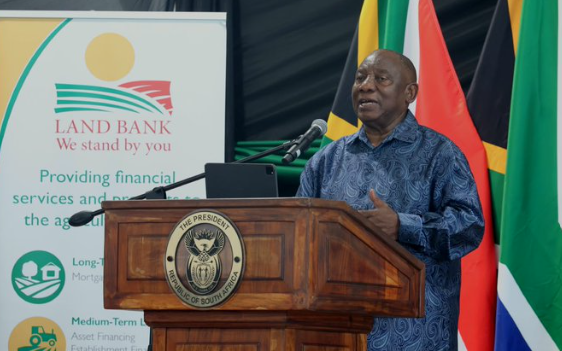
President Cyril Ramaphosa has called for the expansion of successful agricultural enterprises, such as Redlands Dairy Farm, to accelerate land reform, create jobs and drive inclusive growth in South Africa’s rural economy.
Speaking during a visit to the black and youth-owned commercial dairy farm in Stutterheim, Eastern Cape, on Thursday, the President said the Redlands experience demonstrates what can be achieved when access to land is combined with finance, skills, mentorship and strong partnerships.
“We need many more Redlands across South Africa. We must take what works and scale it up,” President Ramaphosa said.
Redlands Dairy Farm has benefited from the Land Bank’s Blended Finance Scheme, implemented in partnership with the Department of Agriculture. The scheme combines government grant funding with loan finance to support viable agricultural investments and enable farmers to build commercially sustainable businesses.
The President identified three key lessons from the Redlands experience, beginning with the need to provide aspiring farmers with more than access to land.
“Too many projects under government’s land reform and redistribution programme have been beset by challenges,” he said.
He said established commercial farmers also have an important role to play in mentoring emerging farmers and transferring practical knowledge.
“Farming, however, is different. It is more of a calling than a profession. In farming, the land is the classroom,” the President said.
President Ramaphosa said farmers gain much of their knowledge through practical experience, including dealing with crop yields and failures, weather and climate change, animal disease and advances in farming technology.
“That is why mentorship and the transfer of practical knowledge are so important,” he said.
The President also highlighted access to finance as a critical bridge between subsistence and commercial farming.
“Yet, many emerging farmers struggle to secure loans. Without assets, collateral or an established track record in farming, they are regarded by major banks as too risky to lend to.
“This keeps them trapped at subsistence level, unable to finance the inputs, infrastructure and additional land they need to expand their operations.
“As government, we recognise this challenge and the need for better ways of financing the crucial step that moves a farming operation from potential to scale,” the President said.
He said blended finance could play a catalytic role in addressing this challenge.
“The real power of blended finance is not simply the amount of grant funding government provides. It is the amount of productive investment that every rand of public funding can ultimately unlock,” he said.
The Blended Finance Scheme was launched in 2022 as a 10-year intervention to support black producers and advance agricultural transformation.
President Ramaphosa said the strong demand for the scheme requires government, National Treasury and the Land Bank to develop sustainable funding solutions to enable more black producers to access affordable finance.
The Land Bank, he said, also needs to be financially sustainable and developmentally effective.
“We will continue to support the rebuilding of the Bank so that it has the financial strength and funding capacity to mobilise capital for agriculture."
Unlocking agricultural growth
The President said government has identified agriculture as a sector with significant potential to create jobs and boost economic growth.
He reiterated that government is releasing land acquired through its land reform programme to black farmers, with about 2.5 million hectares to be released across the country.
“As the land release process continues, the demand for affordable and patient capital by new era commercial farmers will be even greater in the coming months and years,” he said.
President Ramaphosa acknowledged that public resources alone are not enough to finance the scale of agricultural development required, calling on development finance institutions to leverage government support to mobilise additional capital from financial markets, commercial banks, development partners and the private sector.
He also emphasised the importance of opening domestic and international markets to emerging farmers.
“About half of what South Africa produces goes to export markets. In 2025, the value of these exports was around R266 billion.”
He said South Africa is exploring additional markets in BRICS countries, the Middle East and Asia, following progress in accessing the Chinese market.
Agriculture as a driver of rural development
The President said agricultural transformation should extend beyond primary production to processing, distribution and participation in value chains.
“We need developing farmers to progress from primary production into processing, distribution and markets,” he said.
Agriculture and its value chain currently employ around 1.3 million people, with President Ramaphosa saying these numbers needed to grow.
He said expanding productive economic activity is particularly important in provinces such as the Eastern Cape, where agriculture can help address poverty and unemployment.
“This is an opportunity to overcome the challenge of a country and a province with ‘two agricultures’, where we see progress in one part of the farming sector, while the other remains on the periphery of development.”
The President also stressed the importance of strengthening plant and animal health, citing the recent outbreak of Foot and Mouth Disease, as well as investing in seed breeding.
President Ramaphosa congratulated Redlands owner Tshilidzi Matshidzula, his family and the farm team, while thanking the Land Bank, government departments, National Treasury, the Eastern Cape government and other partners supporting agricultural transformation.
“We want a transformed agricultural sector that is productive, competitive, inclusive and increasingly able to contribute to South Africa’s food security and economic prosperity,” he said. – SAnews.gov.za


