


By Dikeledi Molobela
New York, USA — President Cyril Ramaphosa has called for the United Nations General Assembly to back the establishment of an International Panel on Inequality (IPI), saying the time has come to turn growing international concern over inequality into coordinated global action.
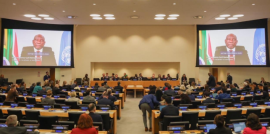
In a pre-recorded message delivered on Wednesday at a high-level event on the margins of the 81st United Nations General Assembly (UNGA), President Ramaphosa said the proposed panel was one of the key outcomes of South Africa’s G20 Presidency in 2025 and should now be taken forward through the multilateral system.
The high-level event, titled “Addressing the Global Inequality Crisis – A High-Level Event on an International Panel on Inequality”, was co-hosted by South Africa, Brazil, Norway and Spain, with Nobel Laureate Professor Joseph Stiglitz.
It brought together leaders, Ministers and representatives of international organisations and civil society to build support for the proposed panel.
President Ramaphosa said South Africa, Brazil, Norway and Spain were united by a common objective of tackling extreme inequality.
“President Lula [Luiz Inácio Lula da Silva], Prime Minister Støre [Jonas Gahr Støre], Prime Minister Sanchez [Pedro Sanchez]and I welcome you as leaders of nations united by a common cause – to overcome extreme inequality,” he said.
He recalled the words of South Africa’s founding President Nelson Mandela, who warned of the consequences of poverty, injustice and inequality.
“As South Africa’s founding father Nelson Mandela reminded us, for as long as poverty, injustice and gross inequality persist in our world, none of us can truly rest,” the President said.
He said the challenge now was to move from recognition of the problem to collective action. The President described the proposed IPI as central to efforts to build a stronger international response to inequality.
“In the spirit of Madiba’s words, let today be a day of action. The task before us is a formidable one, to build a new multilateral frontier and expand our global coalition against inequality. At its heart is the International Panel on Inequality,” he said.
From G20 to the United Nations
The initiative has its roots in South Africa’s G20 Presidency, which placed inequality prominently on the global economic agenda.
An independent committee of experts on global inequality, commissioned by the South African G20 Presidency, recommended the establishment of an International Panel on Inequality to provide governments and multilateral institutions with authoritative assessments and analysis of inequality.
The proposed panel would monitor trends, assess the drivers and consequences of inequality and examine policy responses.
“The decision to establish the Panel is one of the most consequential outcomes of the South African G20 Presidency last year,” he said.
The initiative built on the work of Brazil, which held the G20 Presidency before South Africa, placing inequality at the centre of the global agenda.
The 2025 G20 South Africa Leaders’ Declaration recognised inequality, unemployment, under-employment and informal employment as significant threats to global growth, development and social and economic stability.
The proposed IPI is envisaged as an independent, science-based and globally representative body that would organise, synthesise and assess existing knowledge on inequality and provide evidence to inform policymaking. The initiative draws inspiration from the role played by the Intergovernmental Panel on Climate Change in bringing together scientific evidence on climate change.
Taking the initiative to the General Assembly
President Ramaphosa said the growing support for the initiative should now be converted into a formal United Nations (UN) process.
“As evidenced by the wide range of representation in this room today, the coalition in support of an IPI is growing.
“It is time to accelerate the momentum, and to get the backing of the General Assembly for a resolution on the IPI,” he said.
The UN has described the proposed panel as a potential global body that would provide objective assessments of inequality, systematically monitor trends, analyse drivers and consequences, and assess policy responses at global and national levels.
The 23 September event was specifically convened to build engagement and support for establishing the IPI through a General Assembly resolution.
For South Africa, the initiative represents an effort to place inequality at the centre of the multilateral development agenda and strengthen the evidence available to governments when designing policies to address disparities in income, wealth and opportunity.
The issue also aligns with the broader South African position that global institutions need to respond more effectively to inequalities between and within countries, particularly at a time when developing economies face multiple economic and external pressures.
Building momentum
Drawing on the contribution of Professor Stiglitz, who is a leading advocate of the proposed panel, President Ramaphosa said inequality should not be regarded as an unavoidable feature of the global economy.
“As Professor Joseph Stiglitz reminds us, inequality is not and never has been inevitable. It is a problem we can solve with evidence, analysis and cooperation,” he said.
He called for countries to build on the momentum generated through the G20 and take the initiative forward within the United Nations.
“Let us forge forward in the spirit of cooperation and common purpose,” he said.
President Ramaphosa said the establishment of the panel was no longer a distant ambition.
“An International Panel on Inequality is now firmly on the horizon, and fully within our grasp. The time for an International Panel on Inequality is now,” the President said. – SAnews.gov.za


