


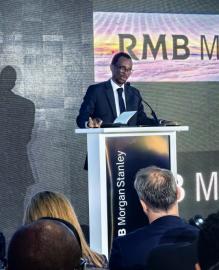
As part of ongoing efforts to achieve fiscal sustainability, government is implementing reforms that will unlock economic growth and is roping in the private sector to invest in infrastructure development, says the Deputy Minister of Finance, Dr David Masondo.
“South Africa’s fiscal path is not without challenges. But we are taking deliberate steps, restoring expenditure discipline, stabilising debt, advancing structural reforms, and strengthening institutions,” the Deputy Minister said on Monday.
Addressing investors, policymakers, and thought leaders at the RMB Morgan Stanley 2025 Investor Conference, Masondo emphasised that government is serious about fiscal sustainability.
Fiscal sustainability is about how government manages expenditure, taxation, and debt in a way that allows it to meet current and future obligations without creating long-term instability.
“The task is to balance caution with opportunity, ensuring that we honour our obligations while creating the space for growth and investment. Together, government and financial markets can help place South Africa’s economy on a more resilient, inclusive, and sustainable footing,” he said.
Metro Trading Services Reform
Through Operation Vulindlela Phase II, a joint initiative of the Presidency and National Treasury, government is implementing structural reforms at local government to improve service delivery.
“Our metros are the engines of the economy, hosting the bulk of our population, businesses, and jobs. Yet years of underinvestment, weak management, and service unreliability in electricity, water, sanitation, and waste services have constrained growth.
“The Metro Trading Services Reform is our response. It aims to create financially ring-fenced, professionally managed utilities within metros, restoring credibility and sustainability to essential services,” the Deputy Minister said.
The initiative offers access to a new R54 billion performance-linked incentive grant that will be strictly conditional on council-approved turnaround plans and adherence to clear accountability standards.
“This is not money for promises, it is money for performance. Only metros that demonstrate measurable improvements in service delivery, financial performance, and governance will qualify.
“The intention is to crowd in investment. For every rand of incentive funding, metros are expected to leverage at least another rand, mobilising an additional R108 billion into infrastructure,” the Deputy Minister said.
Masondo said the impact of the Metro Trading Services Reform will be significant as reliable trading services will strengthen municipal finances, attract investment, and boost urban growth.
“For financial institutions and investors, this reform creates a new opportunity. Lower risk, greater transparency, and stronger governance will open the door for financing water, sanitation, energy, and waste infrastructure, projects that improve lives and generate sustainable returns.
“My message is simple: we invite you to partner with us in this reform. Support our metros, finance the infrastructure that will keep our cities running, and share in the long-term benefits of a stronger urban economy,” he said.
Debt burden
For the past three years, South Africa has maintained a primary budget surplus, which is revenue exceeding non-interest spending.
“This outcome is critical because it reduces the debt burden and lowers debt-service costs, which in turn lowers the sovereign risk premium. As debt-service costs decline, savings can be directed towards fiscal buffers and productive infrastructure, reducing the cost of doing business and supporting growth,” the Deputy Minister said.
South Africa’s gross borrowing requirement is projected to decline to R434 billion in 2026/27 before increasing to R588 billion in 2027/28.
“Over the medium term, we expect to raise US$14.6 billion to meet foreign exchange commitments. We will continue to use a balanced mix of domestic and foreign borrowing, with predictability and confidence as guiding principles. While fixed-rate bonds remain our mainstay, we are expanding our toolkit to include floating-rate notes, Treasury bills, and innovative instruments such as green bonds, sustainable financing, and sukuk," he said.
These instruments not only diversify government's funding but also align with investor appetite and long-term sustainability. -SAnews.gov.za


