


South African women have been at the forefront of the country’s democratic journey, advancing gender equality and paving the way for the recognition of women’s rights in the Constitution.
From leading anti-apartheid resistance to participating in the historic 1956 Women’s March, women such as Lilian Ngoyi, Helen Joseph, Sophie Williams-de Bruyn and Rahima Moosa demonstrated extraordinary courage, resilience and unity in a society where women faced racial and gender discrimination and oppression.
Other women, including Charlotte Mannya-Maxeke, Winnie Madikizela-Mandela and Albertina Sisulu, also played pivotal roles in the broader struggle for freedom and equality.
These gains include greater representation of women in Parliament, the judiciary, the public sector and the corporate sector, with women now occupying top leadership positions.
This year marks 70 years since more than 20 000 women marched to the Union Buildings on 9 August 1956 to protest against the extension of pass laws to women under apartheid.
“Government has made strides. It is not yet enough, but we are working towards that. For instance, in our country, women’s representation in Parliament has only recently been diluted, but we were at 50%.
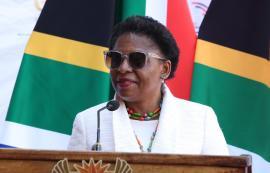
“We regret that representation has declined, and we are challenging political parties to make sure that their representation in Parliament includes women and ensures equal representation,” Minister in the Presidency Khumbudzo Ntshavheni said in an interview with SAnews.
The Johannesburg Stock Exchange recently appointed Valdene Reddy as Group CEO, making her the first woman of colour to occupy the position. She succeeded Dr Leila Fourie, who became the first woman to lead the exchange when she was appointed in 2019. Government has also described Reddy as the first woman of colour to hold the JSE Group CEO position.
“We have women running banks in the country; women taking positions of leadership as CEOs of mining companies, and that is what freedom and the struggle of the women of the 1950s have brought us,” Ntshavheni said.
The year 2026 marks several significant milestones in South Africa’s democratic journey, including the 30th anniversary of the adoption of the Constitution, the 50th anniversary of the 1976 youth uprisings, the 70th anniversary of the 1956 Women’s March and the 60th anniversary of the forced removals from District Six.
These landmark events reflect the long struggle for democracy and freedom, which has contributed to, among other things, women’s economic empowerment initiatives, including employment equity measures, funding for entrepreneurship, education and equality laws.
“Interestingly, employment equity and empowerment targets recognise women across races, because even women of other races, including white women, were oppressed simply by being women. As government, we have put measures in place to ensure that women can be supported across the range of economic empowerment,” Ntshavheni told SAnews.
While gains have been made in employment equity, the Minister called on the private sector to address racial, gender and disability disparities.
The Commission for Employment Equity’s 26th Annual Report shows that the two upper decision-making occupational levels, namely top management and senior management, remain racialised and gendered, with white and Indian population groups, as well as males, dominating these levels. The report covers the 2025/26 reporting period.
The CEE said male representation remains dominant at the top management level, at more than two times female representation.
“We need to start seeing more women, and more Black women in particular, rising in significant numbers. We are seeing, at the lower levels, that Black people and women are coming through, but we want to see that progress also in the higher, senior, and middle strata of the private sector,” Ntshavheni said.
The Minister encouraged women in leadership to actively seek mentorship and support young women in their advancement.
“We were also mentored by others, and it is our job to mentor others. We also call on other women in positions of power to contribute to mentoring young women. The first issue is that young women must prioritise their education. There are support mechanisms available to help ensure that we succeed in our educational endeavours.
“From there, nothing can stop you. It takes hard work, and there will be challenges, but hard work, determination, and calling out for support will get you there,” she said.
Portraits of Power
The Minister paid tribute to struggle stalwart Charlotte Mannya-Maxeke at the inaugural International Portraits of Power exhibition, held by the Charlotte Mannya-Maxeke Institute (CMMI) in partnership with The Presidency of the Republic of South Africa and participating diplomatic missions.
The initiative celebrates extraordinary women whose courage, leadership and contributions have shaped nations and inspired generations through a carefully curated exhibition.
The initiative forms part of a series of legacy projects commemorating the 155th anniversary of Mannya-Maxeke’s birth.
“Charlotte Mannya Maxeke was a woman of remarkable strength and enduring influence, and a trailblazer in every sense. As the first Black woman to graduate with a university degree in Southern Africa, we tend to limit her to being the first Black woman to graduate in South Africa, but she was the first Black woman to graduate with a degree in Southern Africa after obtaining her Bachelor of Science degree on 20 June 1901, from Wilberforce University in the United States of America. Mannya-Maxeke led the path for women’s rights and gender equality,” the Minister said.
Ntshavheni pointed out that Mannya-Maxeke was the only woman present when the South African Native National Congress, later known as the African National Congress, was formed in 1912. Government sources similarly describe Maxeke as the only woman at the founding meeting of the SANNC.
“This is where the power of art becomes especially important. Art has a unique ability to preserve our history, to tell stories that might otherwise be forgotten, and to connect people across cultures and continents. Through exhibitions such as this, we are reminded that art is not only a reflection of society, but also a catalyst for change.
“It builds bridges where there are divides, fosters dialogue where there is silence, and inspires understanding where there is difference. In this way, Portraits of Power serves as both a cultural and diplomatic platform, one that strengthens international understanding while celebrating the shared values that unite us,” she said. -SAnews.gov.za


