


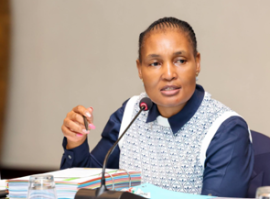
Human Settlement Minister Thembi Simelane has highlighted women's role in the human settlement sector's transition to Innovative Building Technologies (IBT).
Delivering a keynote address at the Women in Human Settlements Sector Dialogue in Johannesburg on Monday evening, Simelane said the IBT must contribute to faster, higher-quality, more sustainable and resilient human settlements.
However, the Minister warned that innovation will be incomplete if it changes building materials and methods without changing patterns of ownership and economic opportunity.
The sector's 2% IBT deliverable, she said, must create opportunities for women as designers, researchers, manufacturers, contractors, inspectors, financiers and entrepreneurs.
“We must deliberately connect new delivery methods to skills, accreditation, finance, project pipelines and market access for women,” Simelane said.
The Minister also pointed to the Property Sector Code as an important framework for advancing transformation through ownership, management control, skills development, enterprise and supplier development, and broader economic opportunities.
From training to real opportunities
The Minister reiterated that empowerment programmes must be measured by what happens after training.
While welcoming programmes being implemented by Human Settlements entities, Simelane said institutions need to adopt a more disciplined approach to measuring outcomes.
“Training is valuable, but it is not the final outcome. Mentorship matters, but it must lead somewhere.”
She emphasised that tangible milestones, including securing a first contract, receiving a first paid invoice, achieving financial close, obtaining professional registration, sustaining a business beyond a single opportunity, and creating employment, are more meaningful indicators of empowerment.
The Minister also called for Human Settlements institutions to operate as a connected system, with each stage of support leading to the next.
“A woman supported by one entity should be able to access the next stage through another: training connected to registration; registration connected to finance; finance connected to a project; a project connected to reliable payment and sustainable growth.”
She identified finance, including collateral, compliance, project packaging, delayed payments, market access and insufficient work experience, as recurring barriers that need to be addressed.
Expectations
Simelane set four expectations before the department, its entities and sector partners. These include institutions knowing their baseline by using verified, comparable information to establish where women currently participate and where gaps remain; and making the opportunity pipeline visible, ensuring that women receive information about opportunities early enough to prepare and compete.
Institutions and entities must also measure progression and impact, tracking the movement from training and support into contracts, finance, employment, professional advancement, ownership and sustainable enterprise growth; and also act on barriers within their control by using procurement, finance, accreditation, supplier development, project packaging, contract management and payment systems to remove obstacles.
“These expectations must enter our existing plans, governance structures and performance reporting,” Simelane said.
She also urged institutions to listen more closely to beneficiaries, saying their experiences often reveal gaps that institutional reports fail to capture.
Beneficiaries, she said, should not simply be showcased at events but should have their experiences incorporated into the design and improvement of programmes.
“Their voices must influence what the institution does next.”
Continuing the work beyond Women's Month
Reflecting on the historical significance of the recently concluded Women's Month, Simelane drew a connection between the women who marched against discriminatory laws in 1956 and the challenges facing women today.
“In 1956, women marched against a system that attempted to limit their movement, dignity, and power. Seventy years later, our responsibility is to remove the barriers that still constrain women's safety, ownership, and economic participation,” the Minister said.
She called on the Women of Human Settlements platform to become a space where policy is tested against implementation, institutions account for measurable progress, industry fulfils its transformation responsibilities, and women's experiences influence future decisions. – SAnews.gov.za


