


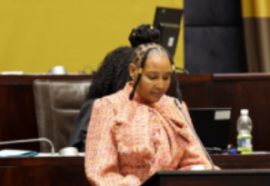
Human Settlements Minister Thembi Simelane has tabled a R26.972 billion budget allocation for the 2026/27 financial year, which outlines ambitious housing delivery targets, despite mounting fiscal pressures and a growing housing backlog.
Presenting the department’s Budget Vote in Parliament on Wednesday, Simelane said the allocation forms part of a broader R81.364 billion Medium-Term Expenditure Framework (MTEF) budget aimed at advancing sustainable human settlements and restoring dignity to vulnerable communities.
Conditional grant funding for the current financial year amounts to R23.679 billion, with provincial departments receiving R15.183 billion and metropolitan municipalities allocated R8.486 billion.
However, Simelane warned that ongoing budget reductions will place significant pressure on the department’s ability to meet its Medium-Term Development Plan (MTDP) targets.
“Our baseline has been reduced by R20.6 billion over the Medium-Term Expenditure Framework. This has resulted in the reduction of Urban Settlement Development Grant (USDG) by R19.7 billion over the MTEF with R5.7 billion in 2026/27, R6.4 billion in 2027/28 and R7.1 billion in 2028/29) to fund the metro trading services,” the Minister said.
Despite the constraints, the department has set a number of delivery targets for the current financial year, and these include:
• Delivery of 39 058 housing units;
• Completion of 25 186 serviced sites across programmes;
• Registration of 21 918 title deeds;
• Delivery of 2 878 social housing units, with 2000 units fully tenanted;
• Eradication of 6 950 mud houses;
• Delivery of 744 housing units for military veterans, and
• Installation of 11 215 solar systems to advance energy resilience and sustainability.
The department also plans to unblock 195 stalled housing projects and ensure that 11 358 First Home Finance subsidy applications are approved, and 9 231 subsidies disbursed to qualifying beneficiaries.
Simelane acknowledged that housing delivery remains below target, revealing that only 23 027 housing units were delivered against a target of 37 779 during the previous financial year.
“This situation cannot continue,” she said, adding that the department will take decisive action against underperforming contractors, and officials responsible for procurement delays.
Significant strides made in housing delivery
Despite challenges linked to land availability, natural disasters and funding constraints, the department reported notable progress in several key programmes during the previous financial year.
Among the achievements highlighted include:
• Eradication of 8176 unhabitable mud houses;
• Unblocking of 85 stalled housing projects;
• Acquisition of 2 447 hectares of land for human settlements development through the Housing Development Agency;
• Delivery of 24 251 serviced sites by provinces, exceeding annual targets of 13 995, and
• Delivery of 3 031 social housing units by the Social Housing Regulatory Authority (SHRA).
The social housing programme also generated more than 12 000 job opportunities nationally, highlighting the programme’s role in supporting economic activity and employment.
In line with the Property Practitioners Act 22 of 2029, the department continued to make significant progress in advancing transformation, skills development, and participation of the previously disadvantaged within the property sector.
“Through the One Learner, One Property Practitioner Programme, we successfully placed 619 candidate property practitioners with property industry employer/host employers, thus strengthening workplace-based learning opportunities and promoting sustainable entry into the sector. We also exceeded our target for women empowerment through the Principalisation Programme, supporting 1 153 women against a target of 484,” Simelane highlighted.
The Minister said government remains committed to leveraging innovative building technologies to accelerate housing delivery and improve climate resilience.
Simelane said government has resolved that at least 2% of the Human Settlements Development Grant (HSDG) may be allocated to Innovative Building Technologies (IBTs)-related housing projects.
The department has also prioritised local manufactures, emerging contractors, youth, women and township-based enterprises, in ensuring IBTs drive inclusive economic participation and job creation.
The Minister noted that South Africa continues to face a persistent, complex and multi-layered human settlements challenge.
The housing backlog currently stands at an estimated 2.6 million units, while rapid urbanisation, historical spatial inequality, and significant unmet housing demand, continue to place pressure on municipalities and housing infrastructure.
Simelane said the department remained committed to ensuring that investments in housing translate into meaningful improvements in the lives of South Africans.
“Housing is more than shelter. It is about restoring dignity, hope and security,” the Minister said. – SAnews.gov.za


