


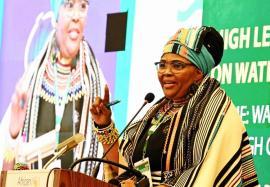
Water and Sanitation Minister Pemmy Majodina has stressed that Africa cannot realise meaningful economic growth without urgent investment in water infrastructure.
“We cannot have Africa developing economically when there is no water,” Majodina said.
Speaking during a media doorstep interview on the margins of the 39th Ordinary Session of the African Union (AU) Assembly of Heads of State and Government, held on 14 – 15 February in Addis Ababa, Ethiopia, Majodina placed water security at the centre of the continent’s development agenda.
The Minister commenced her second day at the summit by hosting, in collaboration with the AU High-Level Panel, a side event titled 'High-Level Leaders Session on Water Investment', sponsored by the Association of Water and Sanitation Institutions in South Africa (AWSISA).
The session brought together Ministers, development partners, financiers, and private sector representatives to assess progress made since the inaugural Water Investment Summit held in Cape Town in August 2025.
Majodina said Africa faces a massive backlog in water infrastructure, warning that without decisive action, the continent’s ambitions for industrialisation, job creation and improved living standards will remain out of reach.
“Let us start rolling out the Water Investment Summit to check how far we can go as a continent in mobilising financial resources to fund water infrastructure. The backlog is huge.
“We cannot have Africa developing economically when there is no water. We need socio-economic development. We need to ensure that livelihoods are sustained as expected. But our people are suffering when it comes to water,” Majodina said.
In a pointed call to action, Majodina linked water security to the AU’s broader peace and stability objectives.
“Everyone talks about silencing the guns. Silence the guns and open the taps. That is where we are coming from. Silence the guns, open the taps.”
She urged African governments and the private sector to make firm commitments toward financing water infrastructure, emphasising that public resources alone will not be sufficient to close the funding gap.
“Let each country commit. Let the private sector commit to water infrastructure investment,” she said.
She emphasised that the mining industry must play a more active role in supporting sustainable water systems across the continent. “We have a lot of mines across the continent operating in our countries, but they are not committing enough in terms of funding water infrastructure.”
Drawing on South Africa’s experience, the Minister cited challenges in the City of Johannesburg, where ageing infrastructure has struggled to keep pace with rapid urbanisation and economic growth.
“When you talk about Johannesburg, you talk about the ‘United Nations of Africa’. Everybody goes there. The economy is growing, the population is growing but the infrastructure can no longer cope,” she said.
The Cape Town Water Investment Summit, held on 15 – 16 August 2025, marked a significant milestone in mobilising funding for the sector. According to Majodina, investors at that summit committed between $10 billion and $12 billion towards water infrastructure development.
In addition, 38 of Africa’s 54 countries submitted bankable project proposals aimed at attracting infrastructure financing.
“We came up with valuable projects from 38 countries... that can be funded. Today, we are here to give a progress report on how far are we in terms of implementing that,” Majodina said.
Stability
The Minister also underscored the link between water and peace, noting that instability across parts of the continent continues to undermine development.
She said water cooperation can serve as a platform for regional integration and shared prosperity, particularly in transboundary river basins.
The Minister further noted the upcoming United Nations Water Conference scheduled to take place in the United Arab Emirates (UAE) from 2 - 4 December 2026.
The conference, co-hosted by Senegal and the UAE, aims to accelerate the implementation of Sustainable Development Goal 6 (SDG 6), enhance global water governance, and further elevate water-related issues on the international agenda.
“As leaders, we must move from declarations to implementation. Water must be at the centre of Africa’s development agenda,” Majodina said. – SAnews.gov.za


