


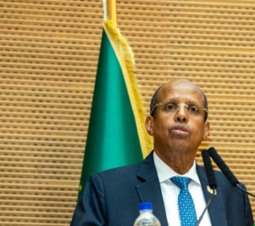
Africa’s future prosperity, development and economic growth require strong economic blocs that are integrated, says African Union Chairperson Mahmoud Ali Youssouf.
Youssouf delivered a statement during the opening session of the 46th Ordinary Summit of Southern African Development Community (SADC) Heads of State and Government, which is currently underway at the Inkosi Albert Luthuli International Convention Centre, in Durban.
The 46th SADC Summit is being convened under the theme: “Resilient, sustainable and inclusive industrialisation through infrastructure development, agricultural and critical minerals transformation in pursuit of a just World”.
Youssouf said that the Abuja Treaty signed in 1991 identified regional integration as an important pillar for Africa’s growth and prosperity.
Now, three decades later, it is the responsibility of African leaders to “make that architecture work more effectively”.
“A stronger African Union needs strong regional economic communities and strong regional economic communities need an African Union capable of ensuring continental coherence and advancing our common priorities.
“Together, let us build an African institutional architecture that is clearer in its responsibilities, stronger in its coordination and, above all, more effective in delivering for our peoples,” Youssouf concluded.
Youssouf noted that SADC has “long been” a pillar of the continent’s march towards integration.
“SADC has long been a pillar of Africa’s integration project. It’s contribution to peace and security, regional integration, infrastructure development and economic transformation extends well beyond Southern Africa and contributes to the realisation of Agenda 2063.
“I am, therefore, particularly encouraged by the strengthening of cooperation between the [AU] Commission and SADC. In line with the 2021 Revised Protocol on relations between the African Union and the regional economic communities, our collaboration has become more regular, substantial and operational,” he noted.
He highlighted that SADC and the AU have worked with closer coordination to resolve the security challenges in the Democratic Republic of Congo and Madagascar.
“Consultations between the leadership of the African Union Commission and the regional economic communities have become more regular, while our mid-year coordination meetings are increasingly focused on substantive issues of coordination, implementation and complementarity.
“We must build on this progress,” Youssouf insisted.
A region at work
Delivering his statement, Executive Secretary of the United Nations Economic Commission for Africa, Claver Gatete, told the gathering that Southern Africa already offers a glimpse of the industrial future sought by Africa.
He listed South Africa’s strong supply networks in the automotive sector, Botswana’s shift into diamond polishing, cutting and trading and Zimbabwe’s investment in lithium processing and others as a demonstration of a region at work.
“The ideas exist. Opportunities abound. What is needed is implementation supported by strategic investments, strong institutions and partnerships around the shared vision.
“Regional value chains must become the cornerstone of Africa’s industrial transformation. Because no single country possesses every resource, technology or capability required to compete globally.
“Together, SADC has the minerals, agriculture, energy, finance, ports, skills and markets needed to build competitive regional production networks,” Gatete said. – SAnews.gov.za


