


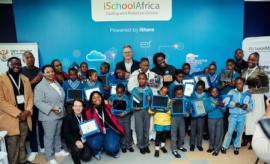
The opening of the iSchoolAfrica Coding and Robotics Centre at Igugu Primary School in Soweto, Gauteng, marks a decisive step toward closing South Africa’s digital divide, ensuring that learners in township schools are no longer left behind in the rapidly evolving world of technology.
Higher Education and Training Deputy Minister, Dr Nomusa Dube-Ncube, joined iStore Education and iSchoolAfrica at the launch of the centre on Tuesday, 12 May 2026.
The initiative is aimed at expanding access to coding and robotics in township communities while bridging longstanding inequalities in digital education.
The launch aligns with South Africa’s broader Fourth Industrial Revolution (4IR) agenda, which seeks to accelerate the integration of technology in education, particularly in under-resourced schools.
Delivering the keynote address, Dube-Ncube described the moment as more than the unveiling of a new facility, but rather a continuation of a historic struggle, one that has shifted from access to basic education to access to the digital future.
She reflected on how previous generations fought for the right to learn, noting that today’s challenge is to ensure that all learners, regardless of their background, are equipped to participate meaningfully in the digital age.
“In 1976, the struggle was for the freedom to choose your language of instruction. In 2026, the struggle is for the freedom to choose your future,” she said.
“Coding is a language. Robotics is a language. Artificial Intelligence is a language. These are the dialects of the Fourth Industrial Revolution.”
Levelling the playing field
For years, access to digital tools and coding education has been concentrated in well-resourced schools, where learners benefit from devices, reliable connectivity and advanced learning environments, compared to many township schools which has limited access to such opportunities.
The new centre in Soweto directly challenges this imbalance.
Describing the facility as more than just a computer lab, the Deputy Minister called it “a launchpad” for future innovation and opportunity.
“When we bring coding and robotics into Igugu Primary School in Mofolo South, we are breaking down a wall. We are saying that geography is not destiny, a postal code should not determine a child’s potential, and that being born in a township is not a limitation- it is a launching pad,” she said.
She emphasised that the gap between learners in under-resourced communities and those in better-funded schools is not one of ability, but of access.
Pathways beyond the classroom
The Deputy Minister noted that initiatives like this extend far beyond basic education.
She said with support from the National Student Financial Aid Scheme (NSFAS), learners who develop an interest in technology can pursue further studies in fields such as software development, robotics engineering, and data science.
Government, she said, is working to ensure that financial constraints do not prevent talented young people from advancing in these high-demand sectors.
Preparing for the future economy
The centre also forms part of a broader national effort to prepare young people for industries driven by technological innovation, including artificial intelligence, renewable energy, electric vehicles, esports, and drone technology.
By exposing learners to coding and robotics early, the Deputy Minister said township schools are being brought into alignment with the demands of a modern economy increasingly shaped by digital skills. – SAnews.gov.za


