


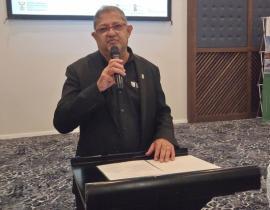
Deputy Minister of Forestry, Fisheries and the Environment Narend Singh has urged authorities to strengthen collaboration to ensure the successful prosecution of those involved in the illegal trade of fisheries resources.
Addressing South African authorities, including prosecutors, the South African Police Service (SAPS) and the Coastal Marine Task Force (CMTF), at a training session in KwaZulu-Natal, Singh said every purchase of unlawfully harvested marine resources contributes to the depletion of a national asset.
The training comes amid reports of the persistent illegal sale of crayfish (East Coast rock lobster) along the N2 near Hibberdene.
“What may seem like a simple roadside transaction is often the visible end of a longer criminal chain involving unlawful harvesting, storage, transport, and sale. These activities place unsustainable pressure on our marine resources, undermine lawful fishers, endanger enforcement officers and the public, and erode respect for the law,” the Deputy Minister said in Scottburgh.
Singh emphasised that protecting South Africa’s marine, coastal and natural resources cannot be the responsibility of any single institution, sphere of government or category of official.
He said this requires seamless, well-coordinated synergy across the entire enforcement and prosecutorial chain.
“Coordinated intelligence, lawful and careful investigation, properly preserved evidence, sound charge sheets, informed prosecutorial decisions, and consistent court follow-through must all function as integrated parts of a single, effective system,” Singh said.
Through the Small-Scale Fisheries Policy, government has allocated long-term fishing rights to 172 cooperatives representing approximately 10 000 fishers.
“We are now shifting focus towards practical support — markets, infrastructure, cold storage, processing facilities, governance, and business development — so that lawful users can thrive.
“Effective enforcement protects the space for these lawful participants to succeed. When we fail to prosecute transgressors robustly, we undermine the very opportunities we are creating for coastal communities and future generations,” Singh said.
During the period April to June 2026 alone, joint operations opened six case dockets under the Marine Living Resources Act, led to nine arrests, issued 22 admission-of-guilt fines totalling R42 000, and resulted in significant confiscations, including 352 linefish valued at R176 000, East Coast rock lobster valued at R31 500, and 47 illegal gillnets valued at R21 150.
“These outcomes demonstrate the power of coordinated intelligence-led enforcement. Yet we must be honest: while progress has been made, challenges remain. Gillnetting continues to devastate estuaries, and complex cases involving undocumented foreign nationals add layers of difficulty.
“Illegal development in sensitive coastal areas such as Umgababa, forestry transgressions, and other offences all require the same integrated response across the enforcement chain,” the Deputy Minister said.
Singh said these successes, as well as persistent challenges, underscore a central truth: effective environmental enforcement is not measured only by arrests and confiscations, but ultimately by successful prosecutions, appropriate sentencing and the ability to protect resources for present and future generations.
“This requires every link in the chain —investigators, compliance officials, and prosecutors — to understand each other’s operational realities, evidentiary requirements, and procedural needs,” he said.
Over the two-day training, authorities will cover key areas, including the Marine Living Resources Act; illegal, unreported and unregulated fishing; the Integrated Coastal Management Act; off-road vehicle controls; municipal development enforcement; forestry legislation; mining and water-use compliance; biodiversity offences; and Marine Protected Areas. -SAnews.gov.za


