


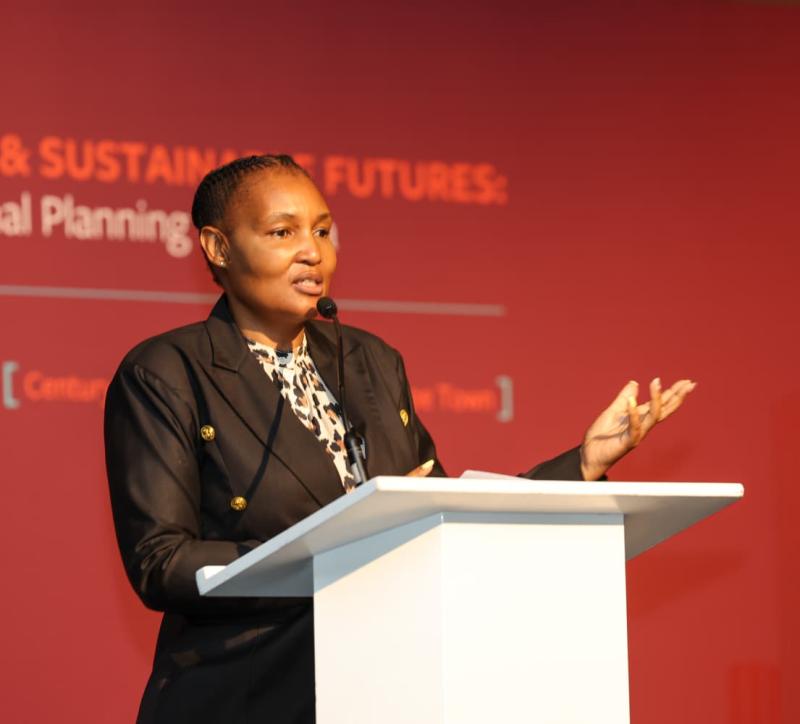
Human Settlements Minister Thembi Simelane has reiterated a call for integrated urban planning, infrastructure investment and the use of digital technologies to address apartheid-era spatial inequalities and improve access to affordable housing and economic opportunities.
Simelane said housing delivery must go beyond the construction of houses to ensure that communities have access to employment centres, public transport, healthcare, education and essential infrastructure.
Delivering a keynote address at the South African Planning Institute’s (SAPI) 10th Planning Africa Conference in Cape Town on Thursday, Simelane said planners have a critical role to play in transforming the country’s settlement patterns and creating inclusive, sustainable and resilient communities.
“Development is sustainable merely because the houses are complete. Water supply, wastewater treatment, electricity, roads, stormwater management and access to public transport must be considered together with settlement growth,” Simelane said.
Held in Cape Town from 29 September to 01 October 2026, the conference is convened under the theme: “Digital Technologies and Sustainable Futures: Pathway for Urban and Regional Planning in Africa.
The conference provides an opportunity for both SAPI and the National Department of Human Settlements to engage different stakeholders, including local and international stakeholders, civil society organisations and local spheres of government, to promote inclusive and participatory planning processes, aimed at addressing spatial inequalities, housing backlogs, climate-resilient settlements, and sustainable rural and urban development.
Simelane noted that South Africa’s settlement patterns continue to reflect the legacy of colonialism and apartheid, with many low-income households living on the urban periphery, far from employment opportunities and essential services.
While significant public investment has been directed towards housing and infrastructure since the advent of democracy, she said the continued separation of residential areas from economic centres places considerable financial and social burdens on households and increases infrastructure costs for municipalities.
She emphasised that housing delivery and spatial transformation are interconnected but distinct objectives, warning that building houses without addressing their location can perpetuate existing inequalities.
“Housing delivery and spatial transformation, while intrinsically linked, are distinct objectives. It thus remains entirely possible to provide houses without fundamentally altering segregated settlement patterns,” she said.
Simelane called on planners to apply the principles of the Spatial Planning and Land Use Management Act, which provides principles of spatial justice, sustainability, efficiency, resilience and good administration, in development decisions.
“We need to institutionalise these principles in our work as planners. Planning outside of this framework of principle can only help to sustain the inherited legacy of spatial injustice. These principles must inform not only where development is permitted, but where public resources are directed and how projects are implemented.
“Spatial transformation must be measured not only by the number of houses constructed, but by where those houses are located, the opportunities they provide access to, and the quality of the settlements we create,” the Minister said.
She also referred to the recent Constitutional Court judgment in the Tafelberg matter, which found that the Western Cape Government and the City of Cape Town had failed to adequately fulfil their obligations in relation to affordable housing and the redress of apartheid-era spatial inequalities in well-located parts of the city.
The Minister said public land and development opportunities should be used to promote inclusion and ensure that low-income households can access housing close to jobs, transport and social amenities.
She urged planners to strengthen coordination with municipalities, water services authorities, state-owned enterprises and other built environment professionals to ensure that infrastructure capacity was considered before new residential developments were approved.
“We cannot build sustainable human settlements by constructing houses first and attempting to resolve the infrastructure requirements later,” Simelane said.
She also reiterated the need to align spatial development frameworks, infrastructure master plans, and capital budgets to ensure that water, sanitation, electricity, roads, stormwater systems and public transport are adequately planned and funded. – SAnews.gov.za


