


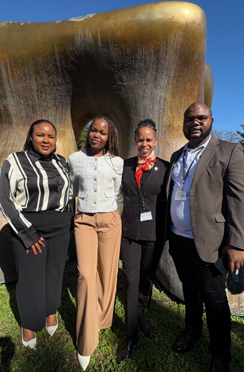
Four South African professionals are connecting the country's public-sector experience with global governance, at the MGG Academy in Bonn, Germany, writes Dr Izimangaliso Malatjie.
In an increasingly interconnected world, public servants are expected to understand not only the challenges facing their own institutions and countries, but also the global forces shaping governance, development and public policy.
This was my experience as a visiting researcher from the National School of Government, alongside my colleague Ntobeko Magubane, Angel Mathebula from the Department of Higher Education and Training, and Tlhompho Shikwambane from the Institute of Global Dialogue, who also participated in the Managing Global Governance (MGG) Academy in Bonn, Germany.
The MGG Academy is an international training and dialogue programme designed for early-to-mid-career professionals shaping the future of global cooperation and sustainability. It brings together experts and practitioners from governmental institutions, think tanks and research organisations, civil society, and the private sector across Brazil, China, the European Union, India, Indonesia, Mexico, and South Africa.
The academy combines academic learning, leadership development, and action-oriented collaboration in an international and diverse learning environment.
For the South African participants, the MGG Academy is more than an international learning opportunity. It is a space for reflection, dialogue and professional exchange. Engagements with participants from diverse countries demonstrated that many public-sector challenges - such as inequality, institutional effectiveness, sustainable development, accountability and leadership - transcend national boundaries.
The experience also highlighted the value of learning from different contexts while critically considering how international lessons can be adapted to South Africa's own developmental realities.
The participants contributed their own experiences of South Africa's public sector and its ongoing efforts to strengthen democratic governance, public institutions and service delivery. South Africa's experience of democratic transformation offers important perspectives to international discussions on governance and institutional development.
At the same time, exposure to international practices encourages the participants to reflect on opportunities for innovation and improvement within their own professional environments. The Academy reinforced a central principle of public-sector development: learning is most valuable when it is shared and translated into action.
A key lesson from the MGG experience was the importance of leadership in navigating complexity. Modern public servants must be able to collaborate across organisational and national boundaries, engage diverse stakeholders, adapt to change and approach problems from multiple perspectives. The Academy's emphasis on dialogue, peer learning and reflection provided the participants with an opportunity to strengthen these capabilities while developing a broader understanding of global governance.
The real impact of the MGG Academy will be measured by what participants do with the knowledge and relationships gained. As knowledge multipliers, myself, Mr Magubane, Ms Mathebula and Ms Shikwambane have an opportunity to share insights with colleagues and contribute to leadership development, research, institutional learning and innovation within South Africa's public service. Their participation also creates opportunities for continued international collaboration and professional networking.
The MGG Academy has demonstrated the power of connecting public servants across borders. For the four South African participants, the experience provided new perspectives, meaningful professional connections and opportunities to reflect on how global knowledge can contribute to local solutions. Our journey represents an important message for the public service: global exposure should ultimately translate into local impact.
As South Africa continues its efforts to build a capable, ethical and developmental public service, investing in public servants who can learn, collaborate and think globally remains an important part of strengthening public-sector leadership. From South Africa to the global stage—and back again—the MGG experience is ultimately about turning knowledge into action.
*Malatjie is the Chief Director responsible for Cadet and Foundational Management at the National School of Government.


