


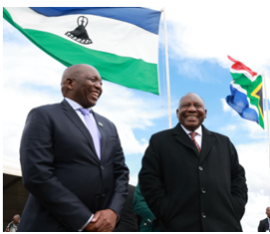
Mokhotlong, Lesotho – President Cyril Ramaphosa has underscored the strength and longevity of relations between South Africa and Lesotho, describing the Senqu Bridge as a powerful symbol of cooperation and shared development.
Speaking at the official launch of the bridge under the Lesotho Highlands Water Project (LHWP) on Wednesday in Mokhotlong, President Ramaphosa said the structure reflects a partnership built on mutual respect, shared history and a common vision for regional progress.
“The Senqu Bridge is a milestone in our longstanding collaboration. This bridge is testament to the deep-seated relationship between our two countries.
“Rising high above the river valley, located more than 2 500 meters above sea level, this bridge has been built to endure. It will serve many generations to come,” the President said.
President Ramaphosa, along with His Majesty King Letsie III, officially unveiled the state-of-the-art Senqu Bridge, marking a major milestone in the long-standing partnership between South Africa and Lesotho under the Lesotho Highlands Water Project.
Set against the highlands of Mokhotlong, the historic moment unfolded as President Ramaphosa arrived by helicopter near the bridge before joining King Letsie III for the official ribbon-cutting ceremony.
The two leaders then unveiled a commemorative plaque bearing the inscription: “Officially opened on 22 April 2026 by His Majesty King Letsie III, Kingdom of Lesotho and H.E President Cyril Ramaphosa in celebration of 40 years of partnership and regional development” .
The Senqu Bridge, constructed at an estimated cost of R2.4 billion, is the largest of three major crossings being developed under Phase II of the LHWP. Measuring approximately 825 metres in length and rising about 90 metres above the river valley, the bridge will play a critical role in maintaining connectivity across the Polihali Reservoir once water levels rise.
President Ramaphosa noted that beyond its engineering significance, the bridge is designed as long-term infrastructure that will improve connectivity, mobility and economic access for communities, businesses and visitors in the region.
“Together with the two other bridges being constructed to span the Polihali Reservoir, this bridge will improve travel across this part of the country, making transport easier and cheaper for communities, businesses and visitors,” the President said.
Constructed in the mountainous highlands of Mokhotlong, the bridge forms part of a broader infrastructure programme aimed at supporting both water security and economic development.
President Ramaphosa emphasised that the project reflects a commitment to inclusive development, ensuring that communities affected by construction are not left worse off, despite the complexities involved.
He highlighted the economic benefits already realised, including the creation of more than 1 200 jobs, largely for Basotho, as well as skills development initiatives such as the Young Professionals Programme, which is equipping graduates with technical expertise in the sector.
The President described the LHWP as one of the world’s most ambitious and successful transboundary water projects and the largest investment South Africa has made beyond its borders.
He also expressed appreciation to the people of Lesotho for their continued partnership in sharing water resources that are essential to South Africa’s economic growth.
“South Africa is a water-scarce country, and the waters of Lesotho’s highlands are vital to our country’s development. We remain forever grateful to the great Basotho nation for making water resources available to us,” the President said.
President Ramaphosa further noted that cooperation between the two countries is expanding across multiple sectors through the Bi-National Commission, including water and energy, infrastructure, skills development, defence and social development.
He said this growing collaboration reflects a broader commitment to regional integration and development, aligned with the vision of the African Union’s Agenda 2063.
“The building of partnerships is very important in a changing, complex and uncertain global environment.
“Guided by the spirit of Pan Africanism, South-South cooperation and solidarity, we are forging ahead to realise the vision of an economically integrated Africa, as espoused by the African Union’s Agenda 2063,” President Ramaphosa said.
The President added that the Senqu Bridge stands as a symbol of African capability and solidarity, demonstrating what can be achieved through partnership and shared purpose.
“This project is more than infrastructure. It is more than steel and concrete. It is a symbol of a deep and enduring partnership.
“The Senqu Bridge is an example of what Africa can achieve when it believes in itself, when it works together to advance the needs of the people,” President Ramaphosa said.
SA pledges R30 million support to Lesotho
President Ramaphosa also announced that South Africa will provide R30 million in humanitarian assistance to Lesotho through the African Renaissance Fund.
He said the funding will support the country’s response to HIV and tuberculosis, particularly in the context of declining international assistance.
The President noted that South Africa will continue to champion regional cooperation through platforms such as the Southern African Development Community, with a focus on strengthening trade, investment and integration across the region.
Background of the LHWP
The Senqu Bridge forms part of the broader LHWP, a multi-phased, treaty-based partnership between South Africa and Lesotho established on 24 October 1986 to address water security, energy generation and socio-economic development.
The project harnesses the Orange–Senqu River system through a network of dams and transfer tunnels, supplying water to South Africa’s Integrated Vaal River System, which supports the economic hub of Gauteng.
At the same time, Lesotho benefits through hydropower generation, infrastructure development and long-term economic opportunities.
Phase II of the project is currently under construction and includes the Polihali Dam, a concrete-faced rockfill structure approximately 165 metres high, as well as a 38-kilometre transfer tunnel that will connect the Polihali and Katse reservoirs.
Once completed, this phase will increase water supply capacity from 780 million cubic metres per annum to 1 270 million cubic metres per annum, significantly strengthening long-term water security for South Africa.
Beyond its strategic importance, the Senqu Bridge is also a major engineering achievement. It is the first extradosed bridge in Lesotho and was constructed using advanced techniques suited to the region’s mountainous terrain.
The project has created significant employment opportunities, with more than 1 200 workers, the majority of them Basotho, contributing to its construction.
The bridge is one of several components under construction in Phase II, alongside the Polihali Dam, transfer tunnel and supporting infrastructure such as roads, power lines and telecommunications. – SAnews.gov.za


