


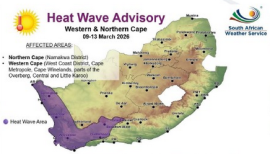
The South African Weather Service (SAWS) has warned that the Western Cape and Northern Cape will experience very hot to extremely hot temperatures due to heat wave conditions this week.
“This follows a brief period of cooler weather. Heat wave conditions are characterised by prolonged periods (at least three consecutive days or more) of temperatures exceeding the average of the hottest month by 5°C or more,” the weather service said.
These weather conditions started on Monday and will persist until Friday.
The heat wave conditions are due to a strong, slow-moving high-pressure system in the upper levels of the atmosphere.
The air in upper-air high-pressure systems sinks and warms as it descends, leading to higher temperatures at the surface. The system will be accompanied by offshore wind flow along the western coastline of South Africa.
“Very hot to extremely hot temperatures (36°C to 42°C) are expected across the coastal areas and adjacent interior of the Northern Cape and the western parts of the Western Cape, from Monday.
“The highest temperatures will occur on Tuesday and Wednesday over the western parts of both the Northern Cape and Western Cape. The heat wave will spread to parts of the Central and Little Karoo on Tuesday.
“Residents are advised to be aware of the prolonged period of hot weather, which may lead to health riskssuch as dehydration, heat exhaustion and heat stroke,” SAWS said.
The weather service has recommended the following precautionary measures to reduce the risk of heat-related illnesses:
Stay hydrated by drinking lots of water.
- Limit outdoor activities, especially during the hottest hours (12h00-15h00).
- Wear loose, light-coloured clothing.
- Stay in the shade or in well-ventilated areas as much as possible.
- Keep an eye on vulnerable individuals, especially the elderly and babies.
- Never leave children or animals in parked cars, even for a short time.
- Avoid strenuous physical activity during the hottest part of the day.
The SAWS will continue to monitor this system closely and will issue updates as new information becomes available.
The public and relevant authorities are urged to follow official weather warnings and advisories from reliable sources. -SAnews.gov.za


