


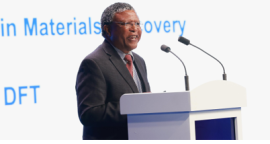
Shanghai, China- South Africa and China are discussing the establishment of a China–Africa Innovation Alliance on Mining and Metallurgy to strengthen mineral-processing research, technology transfer and the development of higher-value products.
Professor Phuti Ngoepe, Director of the Materials Modelling Centre at the University of Limpopo, announced the discussions during an address at the 19th Pujiang Innovation Forum underway in Shanghai, China.
“Currently under discussion between South Africa and China is the establishment of the China–Africa Innovation Alliance on Mining and Metallurgy.
“The aim is to bring the national facilities in South Africa and China together, alongside other role players, to address the challenges we face through research, pilot demonstrations, industry participation, skills development and technology transfer,” Ngoepe said on Saturday.
The proposed alliance could help South Africa extract greater economic value from minerals used in batteries and other clean-energy technologies by strengthening the country’s capacity to process them and manufacture battery materials locally.
Ngoepe said South African researchers were already developing battery-grade input materials from minerals such as manganese and lithium.
“The minerals are processed into input materials used in manufacturing, such as manganese sulphate or copper sulphate, which are required to produce cathodes. The next stage involves purifying these input materials to battery-grade quality,” he explained.
Working with a South African company, researchers recently completed a pilot plant project supported by the Department of Science, Technology and Innovation. The facility is producing manganese sulphate from manganese metal, while a pre-feasibility study on producing it directly from ore has also been completed.
“We have also completed a feasibility study on establishing a 10 000-litre nickel manganese cobalt precursor production plant in South Africa. This work has involved a South African funding body, the government and a university acting as an adviser. We hope the project will now progress to the next stage,” he said.
He said South Africa’s mineral wealth allowed the country an opportunity to participate in the full battery value chain instead of limiting its role to extracting raw materials.
“All these applications depend on our ability to extract minerals from mines efficiently,” he said, pointing to hydrogen-and-battery-powered mining trucks and electric self-driving vehicles as examples of technologies dependent on mineral resources.
Ngoepe highlighted longstanding scientific cooperation between South Africa and China. The two countries began collaborating in mineral-processing research in 2012 and subsequently established a Joint Research Centre.
Research conducted with the Beijing General Research Institute of Mining and Metallurgy, the University of Cape Town and the University of Limpopo uses computational modelling to identify the most effective collectors for separating minerals.
“Through this proof of concept, we demonstrated consistency between the simulations and the experiments. This significantly reduces the time required to synthesise these collectors because the modelling points researchers in the right direction. They no longer have to rely entirely on trial-and-error experimentation,” the Professor said.
The collaboration, he added, also enables researchers to predict how minerals such as copper-bearing chalcopyrite and pyrite can be separated. Machine learning is being used to reduce the lengthy computational times associated with simulating complex, realistic mineral-processing environments.
According to Ngoepe, artificial intelligence, machine learning and quantum computing would increasingly influence materials research. Scientists, he said, are already using graphics processing units to model between 100 million and 200 million atoms, compared with about 30 000 previously.
However, he cautioned that converting scientific discoveries into commercial products required sustained investment.
“Piloting and scaling up are very important, but these stages require substantial investment. Considerable funding is needed, particularly in developing countries where support for research, technology and innovation tends to be limited,” he said.
He stressed that applied innovation remains dependent on fundamental science.
“Basic research is important, and we must continue to invest in it. We must generate the knowledge that will underpin future innovation,” he told delegates.
In his address to the forum, Science, Technology and Innovation Minister Professor Blade Nzimande said rapidly advancing fields such as artificial intelligence (AI), quantum technologies, biotechnology and space science, advanced materials and clean technologies were reshaping economies and national development.
READ | Global South must co-own technologies of the future – Nzimande
-SAnews.gov.za


