


The government has introduced measures aimed at shifting decisively from the export of raw minerals towards the development of competitive local industries.
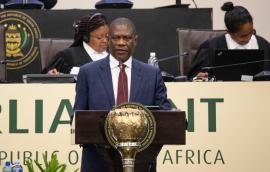
“Government remains committed to ensuring that South Africa builds diversified mineral value chains that create sustainable jobs, expand industrial capacity and broaden economic ownership, particularly among the youth of our country,” Deputy President Paul Mashatile said on Thursday.
He was responding to Oral Questions in the National Assembly as part of Parliament’s oversight and accountability processes.
According to the Deputy President, the government is implementing the Critical Minerals and Metals Strategy approved by Cabinet in May 2025, and the Exploration Implementation Plan aimed at transitioning from raw mineral exports to local beneficiation, high-tech manufacturing, and increased local ownership.
“The Critical Mineral and Metal Strategy is aligned with national efforts to drive industrialisation, promote inclusive growth, and enhance the country's contribution to global clean energy supply chains, including electric vehicles (EVs), hydrogen fuel cells, and battery storage.
“These strategies aim to leverage the global demand for minerals required in renewable energy and digital technologies, such as Platinum Group Metals (PGMs), manganese, and vanadium to build sustainable local industries and create jobs,” Mashatile said.
Furthermore, the Special Economic Zones dedicated to mineral beneficiation will be expanded, offering tax incentives and infrastructure support.
Public-private partnerships will co-invest in beneficiation plants.
“Government is also implementing procurement reforms and enterprise development programmes aimed at expanding market access for youth-owned businesses in both the public and private sectors.
“These measures are aligned with broader industrial policy efforts to promote local beneficiation, strengthen supplier development and broaden participation in the mining economy,” the Deputy President said.
Government is also rolling out technical training programmes through Technical and Vocational Education and Training (TVET) colleges and universities, directly linked to beneficiation industries.
These include mining engineering diplomas, beneficiation academies, and professional certificates in mineral beneficiation, all designed to link directly to the country’s industrialisation agenda.
“Through these coordinated interventions, government remains committed to ensuring that South Africa builds diversified mineral value chains that create sustainable jobs, expand industrial capacity and broaden economic ownership, particularly among the youth of our country,” he said.
Special envoy to South Sudan
The Deputy President further used his time in Parliament to explain his mandate as the President's special envoy, focusing on South Sudan.
He said his mandate is to support the implementation of the Revitalised Agreement on the Resolution of Conflict in South Sudan (R-ARCSS), a legal framework governing South Sudan's transition to peace.
The year 2026 marks a pivotal moment for South Sudan, as the country is earmarked to hold its first-ever elections since gaining independence from Sudan in July 2011.
“Since I assumed the role of Special Envoy in South Sudan, and in pursuit of the peace process, I have undertaken two working visits to Juba, the most recent of which was in October 2025.
“In 2024, I met all the belligerent parties, including meeting with President Salva Kiir Mayardit. Minister Naledi Pandor and I held a meeting with the Head of the United Nations Mission in South Sudan, Nicholas Haysom, who sadly passed away yesterday.
“We subsequently held 15 more meetings with other parties during the four days we spent in Juba. We were convinced that we were making good progress for them to hold democratic elections by the end of December 2026,” Mashatile said.
However, in January this year, fighting erupted once again amongst the belligerent forces and intensified earlier this month, leading to the displacement of over 280,000 people in Jonglei State.
“The latest fighting is yet another illustration of the complexity of the search for peace in South Sudan.
“ South Africa will utilise its role on the African Union Peace and Security Council, for the period 1 April 2026 to 31 March 2028, to mobilise the diplomatic, political, technical, and financial assistance required to support South Sudan in holding credible, free, and fair elections,” the Deputy President said.
He said the government intends to engage the wider international community and various non-state actors, such as non-governmental organisations (NGOs), for a coordinated response to the unfolding humanitarian crisis, which is also exacerbated by the civil war in the Republic of Sudan.
“In this regard, I recently met with the regional leadership of the International Committee of the Red Cross (ICRC) and will continue to engage them on the efforts they are undertaking to respond to the humanitarian situation.
“To resolve this conflict, it is incumbent upon the broad leadership of South Sudan to demonstrate the requisite political will and responsible leadership necessary to implement their own agreement, this being the R-ARCSS,” Mashatile said. -SAnews.gov.za


