


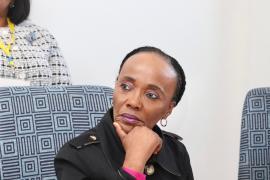
Minister of Women, Youth and Persons with Disabilities Sindisiwe Chikunga has outlined government’s efforts that are intended to protect and promote the rights of persons with disabilities.
Addressing Uganda’s delegations for the South-to-South benchmark visit in Pretoria, the Minister explained that the rights of persons living with disabilities are founded in the Constitution, which recognises that they possess inherent dignity and must enjoy full and equal participation in all spheres of life.
“The White Paper on the Rights of Persons with Disabilities, therefore, does not exist in isolation. It is the practical expression of our constitutional values, a roadmap for transforming noble principles into lived reality for the 7.5% of South Africans who live with disabilities—approximately 4.2 million of our citizens whose potential, contributions, and dreams can no longer be constrained by societal barriers and prejudice,” the Minister said on Monday.
Furthermore, South Africa has committed to implement the United Nations Convention on the Rights of Persons with Disabilities as it offers the international human rights framework.
“The foundation of our approach is the absolute commitment to protecting and promoting the human rights of persons with disabilities in all spheres of life,” she said.
This commitment is backed by the establishment of the Department of Women, Youth and Persons with Disabilities that is responsible for ensuring that all legislation, policies, and programmes comply with constitutional and international obligations.
“We have been deeply involved in ensuring that the Public Procurement Act is responsive to Disability Inclusion,” Chikunga said.
The Act is an overarching national regulatory framework for public procurement across all spheres of government.
It aims to promote efficiency, sustainability, economic development, ethical conduct, and transformative goals in public procurement.
“What we have learnt is that the protection of rights requires vigilance against both obvious discrimination and subtle forms of exclusion embedded in seemingly neutral policies and practices. It demands that we actively dismantle barriers rather than passively avoid creating new ones,” the Minister said.
South Africa also has an Inter-Ministerial Committee (IMC) on Disability Inclusion that is Chaired by the President. Disability Inclusion seeks to challenge the silo approach where disability is sometimes seen as the responsibility of a single department.
“We have come to terms with the facts that education, health, transport, housing, economic development, arts and culture—every sector - must take ownership of disability inclusion within its mandate.
“Working with our colleagues at the Department of Public Service and Administration (DPSA), we will soon be disseminating a circular that will ensure that, across the public service, employment equity targets are not left to chance.
“Breaking the cycle of poverty requires comprehensive economic empowerment strategies inclusive of: Employment, Social protection and Economic participation,” she said.
The Minister emphasised that persons with disabilities must be at the centre of designing, implementing, monitoring, and evaluating all policies and programmes that affect their lives.
“Promoting Social Inclusion, beyond access to services, one of our top priorities is addressing the attitudes, beliefs, and practices that marginalise and exclude persons with disabilities from full community life. Stigma, prejudice, and ignorance remain among the most powerful barriers to inclusion.
“We have conceptualised a Disability Inclusion Observatory Centre of Excellence (Nerve Centre) that will anchor our work in Institutional coordination, Budgeting, Data and research, Monitoring and reporting, Capacity building and Partnerships with organisations of persons with disabilities, disability rights advocates, academic institutions, the private sector, and international partners,” the Minister said.
Sport
South African sport has played a significant role towards transformation.
“Our Paralympic athletes have demonstrated excellence on the world stage, challenging stereotypes and inspiring millions. Our task is to ensure that every person with a disability has the opportunity to participate in sport and recreation, from grassroots to elite levels.
“Disability inclusion is not only a legal obligation but a business imperative. Persons with disabilities represent talent, innovation, and a significant market. Accessible and inclusive businesses are better businesses.
“A society that excludes persons with disabilities diminishes us all. We lose the talents, perspectives, creativity, and contributions of millions. We betray our humanity when we deny others theirs,” Chikunga said. -SAnews.gov.za


