


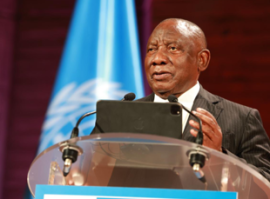
President Cyril Ramaphosa has called on world leaders to move beyond commitments and accelerate the transformation of education systems, saying the world has reached a critical point in achieving quality education for all before the 2030 deadline.
Addressing the Transforming Education Summit (TES+4) at the United Nations Educational, Scientific and Cultural Organisation (UNESCO) Headquarters in Paris on Friday, the President said education remains the most powerful instrument for driving economic growth, reducing inequality and creating opportunities for future generations.
Quoting South Africa's founding democratic President, Nelson Mandela, President Ramaphosa reminded delegates of the enduring value of education.
“The founding father of democratic South Africa, President Nelson Mandela, said that education is the most powerful weapon which you can use to change the world. These words ring as true today as when they were first spoken.
“Education builds. It unlocks human potential. It dismantles ignorance. Every classroom and every lesson empowers the individual to transform not only their own lives but also their communities, their societies and their countries,” the President said.
The President highlighted examples from across the world, including Rwanda, China and India, where sustained investment in education has driven economic transformation and expanded opportunities for millions of people.
He also pointed to South Africa's own progress, describing the country's latest matric results as a source of national optimism.
“Last year, we achieved the highest school-leaving certificate pass rate in our democratic history. What makes this all the more extraordinary is that the majority of those passes qualifying for university entry were learners from poor communities.
“These are young people who will go on to pursue their dreams at a university, technical or vocational college of their choice, where they will study for free. This is a generation taking up opportunity that would have been denied to their parents and grandparents under apartheid,” the President said.
President Ramaphosa said these achievements demonstrate that education is more than a pathway out of poverty.
“These stories are a powerful reminder that when opportunity is extended, education becomes not merely a ladder out of poverty, but a tool with which a nation can transform itself, as President Mandela said,” the President said.
Challenges and improving working conditions
Reflecting on progress since the 2022 Transforming Education Summit, the President acknowledged that while countries had committed to recovering learning losses caused by the COVID-19 pandemic and improving equity in education, significant challenges remain.
“The pandemic may be behind us, but serious challenges remain. Tightening fiscal conditions impact our ability to invest in education. Conflicts and climate-related shocks are disrupting education and displacing millions. At the same time, we stand at the threshold of a technological revolution that will fundamentally reshape the skills our young people need to thrive,” President Ramaphosa said.
He said the summit must honestly assess global progress and ensure that countries remain accountable for delivering on their commitments.
“Our credibility will be measured not by the aspirations we declare, but by the progress we achieve for learners everywhere,” the President said.
President Ramaphosa stressed that teachers remain central to any meaningful education reform, calling for improved working conditions and greater recognition of the profession.
“The teaching profession stands at the heart of any meaningful education transformation. We cannot transform education without transforming the conditions under which our teachers work and the respect with which we treat them,” the President said.
Inclusivity and transformation
The President also underscored the importance of ensuring education systems are inclusive and equitable.
“Similarly, we cannot achieve SDG 4 without prioritising equity and inclusion with absolute clarity and purpose. Inclusive quality education means reaching all learners, whether they are male or female, able-bodied or living with disabilities, urban or rural, rich or poor.
“Without equity at the centre of education policy, reform risks reproducing the very inequalities it seeks to overcome,” he said.
With the world now halfway between the commitments made in 2022 and the 2030 Sustainable Development Goal deadline, President Ramaphosa said incremental reforms would no longer be enough.
“This is not a time for incremental adjustments or business as usual. This is a time for bold, system-wide transformation that builds more resilient, adaptive, and future-ready education systems,” the President said.
He said building resilient education systems would require coordinated global action, sustained political commitment, innovative financing and meaningful participation by young people.
President Ramaphosa also highlighted South Africa's efforts during its G20 Presidency to align global education priorities with Sustainable Development Goal 4.
“During South Africa's Presidency of the G20 last year, we sought to align the outcomes of our Presidency with the SDG4 global agenda by championing foundation quality learning, strengthening the education profession and promoting mutual recognition of qualifications and skills across borders,” he said.
He encouraged member states to maintain strong alignment between G20 education priorities and the work of the Transforming Education Summit while also urging young people to see education as a means to shape a better future.
“Your education is not simply about gaining qualifications. It is about equipping yourselves to solve the problems of your generation. Your education must prepare you not just to inherit the world we leave you, but to transform it,” he said.
SAnews.gov.za


