


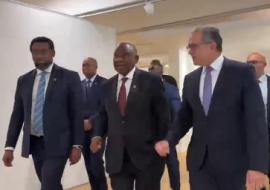
President Cyril Ramaphosa has called for greater global investment in education, warning that quality learning must never become a privilege reserved for a few, as world leaders met in Paris to accelerate progress towards achieving Sustainable Development Goal 4 (SDG 4).
Addressing the SDG 4 High-Level Steering Committee Leaders Group Meeting at UNESCO Headquarters in France on Friday, President Ramaphosa said education remains the foundation for achieving all other Sustainable Development Goals and is essential to building resilient and sustainable societies.
“It is indeed an honour for South Africa to co-chair this Leaders Group meeting alongside the Director-General," the President said.
“SDG 4 occupies a unique position in that it is the bedrock and the enabler of the other SDGs. It is a catalyst for expanding human capability, unlocking opportunity, and delivering progress across the full ambition of Agenda 2030.”
President Ramaphosa said the world faces mounting challenges, including conflict, pandemics, poverty, inequality and climate change, making the global education agenda more important than ever.
“Inclusive and equitable quality education is the key to building resilience and to fostering sustainable societies,” he said.
The President said the committee's work is centred on three priorities: foundational and lifelong learning, strengthening the teaching profession, and promoting inclusive digital transformation.
“Strong literacy, numeracy and socio-emotional skills are the scaffolding that holds up the educational journey. The learning environment thrives and outcomes vastly improve when teachers are capacitated, given the necessary resources, and supported in their work.
“Digital transformation in education is a non-negotiable if we are to adequately prepare today's learners for the workplaces, economies and societies of the future,” the President said.
He stressed that education is both a universal human right and a public good that must be protected from becoming inaccessible to vulnerable communities.
“As such, it must be safeguarded against commodification, and from becoming a privilege that excludes millions of people on account of geography, age, income, gender or personal circumstances. This is what leaving no-one behind means,” President Ramaphosa said.
The President said for education to deliver on its “universal and timeless promise, we have to fix the way it is financed”.
He welcomed the Sustainable Financing Pathways endorsed earlier this year by the Global Partnership for Education, UNESCO, UNICEF, the World Bank and G7 partners, describing it as “a country-owned blueprint that moves us away from fragmented aid to credible, long-term fiscal frameworks”.
President Ramaphosa said leveraging domestic resources, aligning concessional finance and private capital with national priorities and innovative financing instruments such as debt-for-education swaps will be key to closing the education funding gap.
He also warned that corruption, poor planning and financial mismanagement continue to deprive education systems of much-needed resources.
“We know that in far too many instances globally, scarce financial resources that could be invested in education are being lost or whittled away due to mismanagement, corruption and poor planning,” the President said.
Turning to the future of global education, President Ramaphosa said preparations for the post-2030 agenda are already under way, with thousands of young people and education experts helping to shape the next phase of global education policy.
He said consultations involving 20 000 young people from 95 countries revealed growing calls for improved access to education, greater attention to mental health, flexible learning pathways and meaningful youth participation in decision-making.
“Resilience, financing and the post-2030 agenda are streams travelling towards one destination, namely; resilient education systems that anticipate disruption, that adapt with equity, and that are ultimately transformative,” he said.
President Ramaphosa urged governments, development partners and international organisations to translate commitments into action.
“The responsibility now falls to each of us. Member States must embed risk-informed policies into every sectoral strategy, partners must align with country-led investment plans rather than creating new projects, young people must be treated as co-creators and not only beneficiaries, and gender-responsive planning must become the norm,” the President said.
The meeting forms part of President Ramaphosa's official visit to France, during which he is co-chairing high-level UNESCO engagements and holding bilateral discussions with French President Emmanuel Macron. – SAnews.gov.za


