


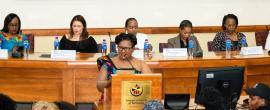
A panel session has called on women not only to support each other, but to embrace innovation and safeguard the truth in an era defined by artificial intelligence (AI) and digital disruption.
Hosted by the Government Communication and Information System (GCIS) in partnership with Tshwane University of Technology (TUT) on Tuesday, the Women in Media and Communication discussion formed part of Women’s Month celebrations.
The gathering was held under the theme: “Leveraging the use of AI in Education, Media and Communication.”
The event brought together leaders in government communication, mainstream media, community media and digital innovation for a robust exchange with TUT students in media, journalism and integrated communication.
Panel moderator and news anchor at the SABC, Bongiwe Zwane stressed that the spirit of community should begin among students themselves, encouraging them to support one another as they prepare for the workplace. She urged young women to see each other not as rivals but as colleagues who can uplift and inspire one another.
“You see a woman whose crown you can fix. You see a woman who is feeling down and doesn't believe in herself, and you realise that I can lift you up, because today, my cup is full,” she said.
“So, I always want you to be cognisant of each other. Everywhere you are, somebody could use your motivation, and I hope that you are going to take everything that we've shared with you today, mull over it, and think of what kind of professionals you want to be,” she said.
The panel featured Pamela Madonsela from the Media Development and Diversity Agency (MDDA); Director for GCIS Parliamentary Office, Liezil Cerf; Head of Digital Communication in the Presidency Athi Geleba and Managing Editor at Code For Africa’s iLAB which trains newsrooms to adapt to the challenges of generative AI Athandiwe Saba.
It also featured Dr Maria Mushaathoni, the Head of Department for Journalism/ Integrated Communication at TUT.
Madonsela highlighted the critical role of community media in telling authentic stories and connecting with citizens but warned that sustainability remains a pressing challenge.
“Sustainability is a challenge to community media, so we're trying to also offer training that is non-financial support to say, how do you make yourself sustainable? We want to see you being able to stand on your own, being able to get ads and being able to run a business,” she said.
Cerf reflected on her career shift from journalism to government communication, saying her passion lies in simplifying complex policy and parliamentary processes for the public.
“Our role is to interpret technical government information in ways that empower ordinary South Africans,” she explained.
Saba warned of the risks of AI-powered disinformation and stressed the importance of training journalists to verify online content.
Meanwhile, Geleba emphasised the Presidency’s role in countering fake news and building public trust.
“I think that as communicators, it becomes quite critical for us to be able to provide information that is accurate; to be able to position ourselves as a primary source for credible government information. With fake news, it's becoming more difficult to be able to detect because of AI and these other technologies.
As communicators, we should be able to educate our various audiences in terms of how to interact with information that they get across platforms,” she said.
Mentorship
The conversation also touched on women’s leadership with Cerf calling for structured mentorship networks.
“Without other women we are not able to reach the full potential of our womanhood within a professional environment. We can’t do it with men; we have to do it with each other.
“I think one of the biggest structural barriers that we have at the moment in our industry, is that we do not have our own network of mentorship and coaching amongst ourselves to share the generational knowledge and wisdom of being in an industry of public communication like myself for more than 25 years.
“When are we going to get together as women and create our own association of women in media? It is time, in those situations that you find yourself in, nothing stops you from creating and formalising networks of encouragement and sharing wisdom. We as the elders would love to connect with you,” Cerf told the audience.
Madonsela urged women to stop with the “pull her down syndrome” and to instead, uplift each other.
“I think as women, the day we stop seeing each other as competition, is the day where we'll be able to hold each other's hands and elevate together. We need to fix each other's crowns as women; let's grow together,” she said.
Meanwhile, Geleba encouraged students to identify mentors and bring their full identities into the workplace.
“I think that it's important for women to really be there for each other, whether it's by way of mentorship and providing support, and as young people who are going into the workplace. I think that it's important to identify women that resonate with you, maybe whose careers you know, career paths that you'd like to follow and build relationships with them.
“There's literally nothing that should stand in the way of young women reaching their full potential. And another thing in the workplace is to bring yourself in your fullness,” she said.
The panel concluded with a call to action for young communicators to use technology responsibly, champion credible information, and support one another in the pursuit of excellence. – SAnews.gov.za


