


Water and Sanitation Minister Pemmy Majodina has stressed the urgency of meeting the 2028/2029 completion deadline for Phase II of the Lesotho Highlands Water Project (LHWP), warning that no further extensions will be granted.
While acknowledging progress made on the project, Majodina said delays could not be tolerated, particularly given that the project had already been delayed by nine years.
“If you are running behind schedule, you must have a clear turnaround plan on how and when you are going to catch up, because we cannot afford to delay this project any further. The taste is in the eating of the pudding,” Majodina said.
Majodina was speaking to stakeholders on Sunday during the first day of her oversight visit to the project, where she received a progress briefing on Phase II implementation. The visit follows her commitment made in August 2025 to return to Lesotho to monitor and review progress.
During presentations, the Minister was briefed on resettlement linked to the dam construction, including the relocation of 24 households to date. She was also informed that approximately 300 households are affected by the project, with construction of 105 replacement houses currently under way.
Majodina expressed concern over the slow pace of relocations and questioned the underlying causes.
“Is it because you are slow, or is it resistance from the community? Why such a low number?” she asked.
She also raised concerns about the criteria guiding relocation decisions, noting reports of requests for relocation beyond Lesotho’s borders.
“Is there no framework to say you can only be relocated up to this far? I’m asking this because I’ve received a lot of petitions where people want to be relocated from here to Ladybrand [Free State]. There’s nothing in the Treaty that says across the borders, and that must be explained thoroughly. You must act within the Treaty,” Majodina said.
The Minister further called for greater transparency regarding expenditure on infrastructure development, particularly road construction.
“How many feeder roads and how many kilometres have been built? You’ve mentioned schools, clinics and hospitals that have been built, but there’s no timeframe,” she said.
To date, R21 billion has been spent on the R53 billion project, which involves the construction of dams and a network of tunnels to transfer water from the Orange–Senqu River in the Lesotho highlands to South Africa, while also supporting hydro-electric power generation in Lesotho.
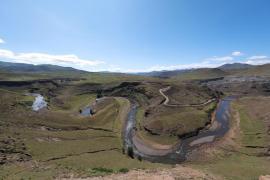
The water transfer component of Phase II includes a 165-metre-high concrete faced rockfill dam at Polihali, downstream of the confluence of the Khubelu and Senqu-Orange rivers, as well as a 38-kilometre concrete lined gravity tunnel linking the Polihali and Katse reservoirs.
Once completed, Phase II will increase water transfers from Lesotho to South Africa by an additional 490 million cubic metres per year, raising total deliveries from 780 million cubic metres to 1.26 billion cubic metres annually through the Integrated Vaal River System (IVRS). – SAnews.gov.za


