


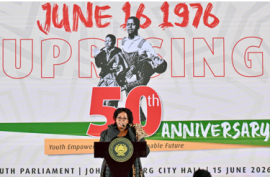
While the youth of 1976 left an indelible mark in the fight against apartheid’s oppressive education policies, paving the way for equal access to education and opportunities, National Council of Provinces Chairperson Refilwe Mtshweni-Tsipane has urged today’s youth not to become passive members of society.
“To this end, our repeated call to the youth of today is to remember what the struggle was for. It is for the youth to pick up the baton and not become passive recipients of government, private and public interventions. It is for the youth to reclaim education as a site of struggle,” Mtshweni-Tsipane said on Monday in Johannesburg.
She was addressing the National Youth Parliament, convened to commemorate the 50th anniversary of the 1976 Student Uprisings and 30 years of South Africa’s transformative Constitution.
National Youth Day is celebrated on June 16 to honour the role young people played in the fight against apartheid and the Soweto Uprising of 1976.
“In commemorating this historic occasion, the current generation must properly locate the essence of the 1976 struggle to understand present challenges as part of the long arc of liberation.
“This was a moment in our painful history when the youth, the children of Soweto and across the country, did not wake up intending to die. Rather, they chose to take ownership of their future through a protracted struggle to confront and combat their oppression,” the Chairperson said.
She added that the youth-led uprising of 1976 became the focal point of opposition when other organisations fighting for liberation had been banned and many leaders were in exile, underground or imprisoned.
“It was characterised as a period of people's power, where apartheid rule was being displaced in all corners of society through forms of self-government across our communities.
“It was a period of liberation of consciousness from psychological and political oppression, helping to rebuild political unity and self-determination,” Mtshweni-Tsipane said.
She therefore called on South Africans to help address contemporary challenges such as transformation and access to quality education, as a means to reclaim the present and the future, and confront precarious labour conditions in a changing world of work to redefine a different development path.
Furthermore, she said young people should mobilise a multi-sectoral compact to accelerate youth development and policy implementation, and reassert the role of a democratic Parliament as the epicentre of lawmaking, oversight and public participation.
“As Parliament, we have committed ourselves to becoming more deliberate in deepening accountability and strengthening state capacity to deliver services to our people.
“Let us be inspired by the sacrifices of the youth of 1976, who showed that the future of South Africa depends on the determination of its young people. Passivity, drug abuse and alcohol abuse do not build nations,” she said.
The Chairperson also encouraged young people to reclaim democracy by registering to vote and deciding the kind of country and world in which they wish to live.
“The multiple, interlocking and interrelated challenges facing young people are not the problems of the future; they are the problems of the present. It is time to make your mark and contribution through all sites of people's power, especially through our municipalities, legislatures and Parliament,” Mtshweni-Tsipane said.
She stressed that the struggle is not yet over.
“It has moved from the streets of our communities to different sites of contestation in universities, industries, corporations, the spaces of arts and culture, spirituality, sport and other aspects of social life. That is why some political thinkers say the struggle feels different today,” the Chairperson said.
She invited participants in the Youth Parliament to contribute meaningfully towards creating renewed ways of life through an oversight agenda that affirms freedoms, even under conditions of scarcity and constraint.
“Parliament is a theatre of contestation, ideas and oversight, and a necessity in developing a transformative strategy for social change.
“Thus, our presence here today in the great city of Johannesburg is to give credence to all voices, especially those of the marginalised, the unemployed and poor youth, against a history of erasure that the youth of 1976 sought to end,” the Chairperson said. -SAnews.gov.za


