


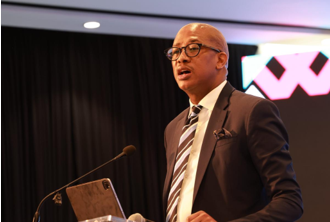
Deputy Minister in the Presidency Kenny Morolong has called for stronger coordination, accountability and accuracy in government communication, saying a digital-first public service must ensure that citizens receive reliable, timely and accessible information.
Addressing the Meta For Government Summit, in Johannesburg earlier today, Morolong emphasised the importance of strengthening the Government Communication and Information System (GCIS) as the central coordinating department for government communications and public information.
He said digital transformation should not only focus on the speed at which information is shared, but also on the accuracy, accessibility and reliability of public communication.
“For government, it is a failure of organisation. Somewhere between the official who verified the information and the person who needed it, the State lost the ability to speak with authority,” Morolong said.
Morolong said public institutions must be able to record decisions, retrieve information, establish responsibility and correct errors, adding that digitisation makes these responsibilities even more important, as inaccurate information can spread further and faster.
He highlighted Section 195 of the Constitution, which requires public administration to foster transparency by providing timely, accessible and accurate information.
“Information about an application deadline has little value if it arrives after the closing date; if it is impossible to understand or if it directs people to the wrong office,” he said.
Referring to the recent strategic planning session of the GCIS, Morolong said Minister in the Presidency Khumbudzo Ntshavheni had reaffirmed the importance of a digital-first strategy that enables government to respond at the speed at which people receive information, without compromising verification.
He said giving effect to the Minister's direction requires positioning the GCIS as the premier department responsible for coordinating government communications and public information.
This includes setting common standards, aligning communication across the three spheres of government and helping to resolve conflicting messages, while ensuring that the relevant authority remains accountable for confirming information and explaining decisions.
Morolong said a digital-first operating model must begin with clearly assigned responsibilities, particularly during emergencies.
He added that official notices should indicate when they were issued and updated, as well as provide channels through which the public can access the latest information.
“If information changes, the correction should travel through the same channels as the original,” he said.
The Deputy Minister stressed that digital communication must be supported by broader communication channels, including community radio, municipal call centres and ward structures.
Using water interruptions as an example, he said notices should clearly identify affected areas, indicate where residents can access drinking water and provide timelines for subsequent updates.
Morolong also pointed to Izimbizo and community dialogues as important platforms for government to establish where communication has failed and whether public instructions are easy to understand and follow.
He said the effectiveness of government communication should be measured by the difference it makes in people's lives.
“Did eligible applicants complete the process? Did households act on a warning in time?
“How quickly did we correct an error, and did the correction reach those who saw the original? These are stronger measures of public value than impressions alone,” he said.
Morolong said the recent local government elections had illustrated the importance of protecting the integrity of information while respecting freedom of expression.
He noted that the Electoral Commission had promulgated a code ahead of the polls to counter disinformation and address conduct that could undermine free and fair elections, while protecting lawful criticism, fair reporting, satire and legitimate debate.
He also highlighted the growing impact of artificial intelligence (AI) on government.
“Where we use AI, a named official should remain accountable for the published output. That means checking translations and factual claims, protecting personal information, retaining the records needed to explain decisions and giving people a way to reach a person when an automated response fails them,” he said. – SAnews.gov.za


