


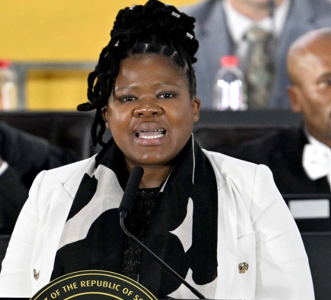
Deputy Minister in the Presidency Nonceba Mhlauli says the Presidential Youth Employment Intervention (PYEI) recorded more than 2.6 million temporary earning opportunities for young people since its inception in 2020.
“We are reporting opportunities through which young people have been supported to participate economically, gain experience and move along a pathway towards sustainable earning,” Mhlauli said.
Releasing the Presidential Youth Employment Intervention Quarterly Report for the 2026/27 financial year in Pretoria on Wednesday, Mhlauli said government recognise that temporary opportunities alone cannot resolve South Africa’s youth unemployment challenge.
“This is why the PYEI also focuses on systems change, demand-led skills development, enterprise development, sustainable earning pathways and connecting young people to opportunities through a national network,” Mhlauli said.
Mhlauli said for a young person who has never had the opportunity to enter a workplace, gain practical experience or earn an income, such an opportunity can provide an important bridge into further economic participation.
Mhlauli said the first quarter of the 2026/27 financial year, the PYEI recorded 139 693 earning opportunities secured by young people through the National Pathway Management Network.
“Of these, 106 093 opportunities were secured through SA Youth, while a further 33 600 earning and learning opportunities were secured through ESSA,” Mhlauli said.
Mhlauli close to 70% of opportunities have been accessed by young women, demonstrating the network’s contribution towards addressing gender disparities in access to economic opportunities.
Mhlauli said during the first quarter, the Youth Employment Service (YES) placed 5 244 young people into workplace experience opportunities.
“Workplace experience is important because qualifications alone do not always provide young people with the practical experience required to enter the labour market,” Mhlauli said.
Mhlauli said the PYEI places emphasis on creating pathways that allow young people to apply what they have learnt and develop practical workplace skills.
“We also made progress through the Revitalised National Youth Service. During the quarter, a further 2 866 young people were recruited into Phase 5 of the programme.
“This is the largest phase of the Revitalised National Youth Service to date and is recruiting 100 000 young people across South Africa. Since inception, the National Youth Service has provided 140 922 paid service opportunities across its five phases, with young women accounting for 68% of these opportunities.
“During the first quarter, the National Youth Development Agency provided 5 214 enterprise support opportunities, consisting of 4 795 non-financial and 419 financial opportunities,” the Deputy Minister said.
The Deputy Minister said across the ecosystem, enterprise support opportunities have now reached 277 349 since inception.
“We are also investing in new approaches to addressing the barriers young people face. During the quarter, R95 million was committed to the fourth Call for Proposals, with a focus on strengthening economic linkages in rural and marginalised communities, supporting sustainable earning, expanding participation by young people living with disabilities and deepening the participation of civil society and youth-led organisations,” Mhlauli said.
According to Mhlauli, as of 30 June 2026, the Innovation Fund portfolio had facilitated access to more than 32 000 earning opportunities, with more than 52 000 unemployed young people registered across the Fund.
“The progress reported today must also be considered against the broader targets of the PYEI. The intervention set a target of engaging at least 5 million young people in the National Pathway Management Network.
“We have now exceeded that target, with more than 6 million young people registered and accessing opportunities through the network. The second target was to support young people to access 1.5 million temporary earning opportunities. To date, young people have accessed more than 2.6 million,” she said.
Mhlauli said government is targeting to engage 500 000 young people in sustainable earning opportunities through workforce development programmes.
“This remains a work in progress, with evaluations and tracing studies underway. This is an important measure of accountability. The impact of the PYEI cannot be assessed only by the number of young people who access an opportunity.
“Young people need pathways that are accessible, relevant, and connected to real opportunities in the economy. They need opportunities to gain experience, earn, develop skills, establish enterprises and progress towards sustainable livelihoods.
“The PYEI cannot address youth unemployment alone. The scale and complexity of the challenge requires continued cooperation between government, business, civil society, educational institutions, and other partners,” Mhlauli said.
The PYEI is a comprehensive, multi-stakeholder intervention designed to accelerate the transition of young people from learning to earning. It brings together government departments, public entities, the private sector, civil society, and other partners to address the barriers young people face in accessing economic opportunities. – SAnews.gov.za


